Thursday, 20 December 2012

WTO Ruling Against Ontario Renewables policy isn't about subsidizing renewables ... yet

The World Trade Organization (WTO) has issued it's rulings in disputes involving Ontario's renewable energy generation sector, finding, as previously reported, against the local content provisions of procurment programs, but not ruling against the feed-in tariff (FIT) program as a subsidy that violates WTO agreements.
In the press:
Richard Blackwell opened his article in the Globe with "Canada will appeal..."
The article quotes a Stuart Trew of some council of some Canadians to opine:
If there is no way to provide incentives for green energy in a free market system, “there is little hope of reducing our greenhouse gas emissions and addressing the climate crisis...”
The ruling on local content has little relevance to the provision of renewable energy.  Japan's successful complaint was about procuring Ontario manufactured renewable energy - not about procuring renewable energy.

The European Commissions welcomed the ruling by stating it wants to export product to Ontario.

John Bennett, of a rumoured Sierra Club in Canada,  is interviewed:
... it is ironic that Japan and the EU were the source of the complaints, because they use subsidies and support for their solar and wind industries. He said he would advise the next premier of Ontario to ignore the ruling “like the Prime Minister is ignoring the Kyoto Protocol.
The Prime Minister that ignored the Kyoto Protocol is the one that initially signed it.  The current Prime Minister gave it all the attention required to withdraw from it.


This Prime Minister should ignore Ontario's request to appeal the ruling.
A spokeswoman for the federal Department of Foreign Affairs and International Trade said that “as this is the first time Canada has received a WTO panel ruling arising solely from provincial policy or legislation, the government of Canada will be appealing the decision as requested by the government of Ontario.”
Proponents for renewables should also want the government of Canada to stop acquiescing to Ontaio's whimsical requests.

There were two disputes heard, with Canada - meaning Ontario - being fournd "in breach of its obligations" on the content requirement, but not on the feed-in tariff (FIT) constituting an illegal subsidy.  While the finding  of breach was unanimous, there was a minority opinion on the FIT that should be treated as a warning to people like Stuard Trew, John Bennett, and the other nice folks who want to keep the FIT scheme running.
...by bringing these high cost and less efficient electricity producers into the wholesale electricity market, when they would otherwise not be present, the Government of Ontario's purchases of electricity from solar PV and windpower generators under the FIT Programme clearly confer a benefit upon the relevant FIT generators, within the meaning of Article 1.1(b) of the SCM Agreement. 
The appeal might have the consequence of getting the entire FIT scheme abolished.
The European Wind Energy Association (EWEA) is urging the European Commission to use the ruling to open up trade to "bring more renewable energy online and drive down costs."

Canada, driven by Ontario's FIT program, is reportedly the only jurisdiction in the world with rising prices for solar photovoltaic modules.

While the majority of the FIT program has been in disarray, and inactive, for some time, the one component where contracts are being offered is the smaller scale solar niche - a niche consultants advised the government to pursue to maximize vote buying.  

Other FIT categories are now seeing growing attrition rates in the planned projects (perhaps a third of all projects holding FIT contracts).  Much of the hesitancy to proceed with projects should be due to the fact Ontario's grid won't be able to accept much of it, but there's also revenue uncertainly being generated elsewhere in the world:
A broad coalition of international PV groups has pleaded with the European Commission (EC) to help soften or reverse the recent outbreak of laws seeking to claw back money and support pledged to solar-energy installations. - Recharge
Efforts to claw back some of the exhorbitant contract costs may come to pass in Ontario too.  "I stole it fair and square" is still presented as a legitimate argument here - it's usually described differently, such as, "the government needs to honour it's contracts."

Which may be true.

That would be a reason for Canada to honour the WTO ruling and ignore Ontario's request to file a baseless appeal that is as likely to lead to rulings threatening subsidies for generation throughout the world as it is to allow a handful of rent-seeking firms to generate some very expensive, temporary, employment in Ontario.

Tuesday, 11 December 2012

Whose Meter Is It: Dopey Ontario and Smart Meters

Another data management debacle in Ontario.
Smart technology refers to components that can communicate, the communication protocols and networks, the servers, the software, the security protocols, the network architecture controlling access.  Our governments seem to lack the technical expertise in information technology and the bureaucratic backbone to face down poor direction. 

I've just read through Access to Consumer Data: A Vignette from the Ontario Smart Grid Forum
Beyond the needs of TOU billing by utilities however, lie a wider range of products and services – many of which may be enabled by real‐time or near real‐time metering data. Access to real‐time smart metering data has been a topic of extensive examination and discussion by the Ontario Smart Grid Forum, particularly in the context of enabling the concept of the “smart home”.  Access to real‐time data is the focus of this informational ‘vignette’.
The Smart Grid forum considers smart homes desirable, spends some time noting competition for smart home services is desirable, and quotes a previous report noting:
"Unlicensed third‐party service providers, for example, want access to customer smart meter data so they can design and commercialize new energy products and services for residential, business and industrial consumers.”

Well, one main goal of old school local distribution companies was security, and old school security quite often meant proprietary and unique protocols - which would be the opposite of open access and open architecture.
Ontario’s Advanced Metering Infrastructure (AMI) systems pre‐date many emerging interoperability standards which might assist in the controlled and secure exchange of real‐time smart metering data between third parties and LDCs.   As a result, there is presently no single common approach for third parties wishing to offer products and services that require real‐time smart metering data. This will be a reality in the province for many years to come. In order to overcome this interim barrier, the Ontario Smart Grid Forum recommended in its May, 2011 report, the establishment of a common AMI test bed facility for the province where third parties can develop and test interfaces with the various different propriety AMI standards currently in use in the province.
But ... all the meters are new.
In 2004 data issues were well known to data professionals.
As Canada's long-gun registry (a $2 billion database program), and the eHealth largess in Ontario should have indicated back in the day, our governments aren't strong at data management.

Ontario's desire to be smart grid pioneers through the rapid roll-out of smart meters was done with little inital data design discipline.  This "vignette" demonstrates the premature roll-out has wiped out any early adaptor advantage already.
Green Button Initiative:  A fast‐emerging solution being developed under the auspices of the United States National Institute of Standards and Technology (NIST) Smart Grid Interoperability Panel (SGIP) offers a non‐proprietary alternative to data access.  Its potential adoption in Ontario could be seen as an alternative approach to the AMI Test Bed facility.
Could be.
Hell ya... could be.

Proprietary leanings already killed the Google PowerMeter and Microsoft Hohm projects, initiated back when, for some reason, the IT giants assumed individuals would have access to "their" metering data, perhaps real-time pricing signal and the ability to control their electricity consuming devices across a network, presumably, the one we call the internet.

The 'vignette' shows item 1 of the Smart Grid Forum's progress check as
1. "...[LDCs] should retain the ultimate responsibility for confidentiality of data while it’s residing in their meters."  
The key word here is "their". Consumers could control their own electricity use without any utility involvement beyond a connection to receive metering data, real-time ~ and the utility could push pricing signals securely in real-time separately from the metering.  The Progress Check's second point notes a theoretical desireability of customers having "ultimate control over data release," but that skirts the real-time issue for controllinging consumption.

This small issue, of ownership of the data being collected at the meter, comes more into focus when la 'vignette' notes: 
3. The Energy Services Interface (ESI) between the utility’s systems and those within a customers’ premise needs a clear demarcation point for liability over the data ...
Exactly.
A push interface would resolve liability quite quickly - allowing the customer to register a device they own that could recieve pushed data from the utilities meter:  a one-way push interface to a single point on the consumer side, which the consumer owns and is responsible for securing.

I suspect the security issues are complicated by a desire for push and pull - meaning the ability to control consumption devices in the residence, and the ability to collect a new revenue stream.

I received an offer to join a PeakSaver Plus program last week, from my distribution company.  In order to take advantage of the expensive program you need to have a single family dwelling with a central air conditioner in working order.  That program is funded by money the Ontario Power Authority takes from ratepayers through the global adjustment mechanism.
Ratepayers including food bank users, the former horse owners who have searched for somebody to give their horses as feed prices are way up and revenue likelihoods are way down, and a broad collection of others struggling without a well-functioning central air-conditioning system in a single family home.

Apparently, the smart grid is to enable elitists to implement regressive policies.

Unfortunately for elitists, populists have contrary opinions of what the devises might be good for.

Now that we know the utility can communicate with central air, lets charge triple rates for electricity consumption by central air devices.
It's a huge issue in Ontario, which was for most of it's years a winter peaking jurisdiction.  The growth in summer demand is an issue, and, fortunately, we now have a list of homes with central air which we can charge inflated electricity rates to recover the capacity costs for units needed above the winter peak demand needs.
There are other consumption pigs we could put heavier prices on too - pool pumps, for instance.

It's likely wiser to keep electricity providers as electricty providers and avoid chosing rich people to reward with bling thermostats on the basis that because they use the most they offer the greatest opportunity for reducing demand.

Your utility should be your electricity supplier.

You should have access to the data your utility collects from the meter they charge you from.
Others should not.

The latest communication from the Ontario Smart Grid Forum hints that Ontario's best course is now to adopt the standards being developed, and implemented, in the United States.  If they want to do something intelligent, they'll adopt that course and go the added step of preventing utilities from collecting revenues from any type of meddling with controlling consumption on the other side of the meter.


Thursday, 6 December 2012

Darlington Refurbishment is the best option.

The Canadian Nuclear Safety Commission (CNSC) is currently holding hearings on licensing related to the continued operation, and refurbishment, of the Darlington nuclear generating station.  There are many groups, and individuals opposing the extension on all sorts of grounds, but the main tactic of anti-nuclear campaigners is to argue that other options were not explored before choosing nuclear.
What might be considered to replace the Darlington nuclear generating station?

The Globe and Mail's Richard Blackwell wrote an article, as the hearings started, that told of a nuclear industry attacking a solar industry. "Solar industry urged to push back against nuclear 'attack'" accused the Canadian Nuclear Association (CNA) and the Ontario Power Workers Union (PWU) of "labelling renewables such as wind and solar as “intermittent” and expensive, and encouraging more investment in nuclear."  


There are good reasons for Darlington's supporters to label solar as "intermittent."  In 2011 there were only 15 hours when Darlington's capacity factor was below 70%.  OPG reported the 'capability factor' of Darlington to be 95.2% in 2011, which was a record, but not far above it's average for the past decade of ~89%.

There is little reporting on hourly production of solar production.  I've grabbed an average hourly output for an array in London, Ontario, and adjusted it to an 18% capacity factor.  The most common output level is 0, which is the output level for all winter peak hours: in 2011 the winter peak was 22,733 MW, but surprisingly the highest demand levels where solar would have been unproductive were just after sunset on some hot July evenings.  Demand dropped from 24,869MW to 23,600MW between hours 20 and 22 on July 21st, off the day's, and year's, high of 25,450 at hour 16.

The Ontario Power Authority last reported it's contracts for "in-service" and "under development" solar capacity as 2,018MW.  That would seem to be in the ballpark for the difference between winter and summer peaks, and summer daytime and summer nighttime peaks.  Above this level, solar capacity would need to be accompanied by another technology if the stability of Ontario's grid is to remain - whether that be gas, coal, or some as yet unknown storage capability.  All options should be accounted for as an additional cost of intermittent supply.   Without additional supply costs, an infinite amount of solar PV capacity could not replace Darlington's output over half of the time.

The problem in pushing back against arguments that solar is intermittent and expensive is that solar is intermittent, and if you are trying to replicate the production of Darlington, it is expensive.

Wind also cannot be relied on for supply (I've written on the subject extensively).

In order to estimate the costs of replacing Darlington, I've looked at the wind and solar capacities required to generate the same annual output as Darlington (roughly 30TWh): I've used 3173MW of solar capacity operating at an 18% capacity factor, and 9376MW of wind capacity operating at a 29% capacity factor.  I've based figures on 2011's actual figures for Ontario Demand, wind turbine locations in service prior to 2011, Darlington's hourly production, and the generic solar profile (in the absence of any useful government reporting).  The total capacity breakdown is the required renewables' capacity using a proportional mix expected from Ontario's Long Term Energy Plan (LTEP - 2700/8000MW).

The distribution of hourly generation is much different.  The spreadsheet embedded below shows the forecast average generation (by month and hour of day) from the 12,549MW of renewable (wind/solar) capacity, less the actual generation from the 4 units at the Darlington nuclear facility.


Surplus baseload generation (SBG) would often be less of an issue under this scenario, where renewables replace Darlington, except in the shoulder months, or months of unusually strong wind output - and these are already the periods of the most significant SBG events.

To achieve the same annual production of Darlington wind and solar only produce more than Darlington 40% of all hours.  During those hours, the wind/solar mix would produce ~8.5TWh more than Darlington, of which 3.8TWh could replace a fossil fuel source and 4.8TWh could not (within Ontario).  During the other 60% of the hours, either nothing would replace the difference to Darlington's output, or fossil fuel based generation would.

Attempting to replace Darlington's generation with an equal output of generation from wind and solar would increase emissions in Ontario.

The distribution is also problematic in that while most months will see higher production during afternoons, the expected annual peaks are in hour 16 of July, which is an hour that the modeling shows as losing generation if 12,549MW of renewable capacity replace 3,512 MW of Darlington capacity.  In both years I applied the model to, there is an additional need for ~1500MW of capacity to meet peak demand in the renewables scenario.
In order to replace Darlinton's production by emphasizing wind and solar, four times Darlington's generating capacity is required.

My estimate of average cost for the renewable generation needed to replace Darlingon, based on feed-in tariff contract rates, is $195/MWh, with a minor increase for the procurement of extra natural gas-fired capacity, and ignoring the significant costs required to build out the grid - and ignoring the generation that would need to be curtailed due to grid congestion.

Slide 38 IPSP Stakeholder Consultation Supply Presentation
The Ontario Power Authority's 2011 hearings in preparation of an Integrated Power System Plan (IPSP 2) did cost out a range of supply options.  The cost of "Nuclear Modernization" (refurbishment) was estimated in the $50-$90 range - and that does not require procuring additional fossil fuel generation and utilizes existing grid assets.  Even at the high end of the Darlington's refurbishment estimates, the option is over $3 billion a year cheaper (total market value is currently ~$10 billion), and has fewer emissions.

$3 billion is roughly the figure that utilities today would be expected to make annually off of an equity valuation of $30 billion dollars, which is roughly the old Ontario Hydro debt before it was broken up, and the 'residual stranded debt' (RSD) and formerly related debt retirement charge (DRC) were created..

There always seems to be a group that figures public power is depriving them of $3 billion.

The DRC hasn't been going to pay down the RSD for years, but that should come as no surprise to those who have looked at the activities around Ontario Hydro in the 1990's, as Darlington's 4 units were coming online.  In 1992 Premier Bob Rae abandoned the "power at cost" mandate of Ontario Hydro, and around that time rates were also frozen.  In the following years cost cutting brought down Ontario Hydro's debt (during the rate freeze), but performance at the generating stations also worsened with the cuts, which lead to the shuttering of 7 nuclear units.  The write-down on the units became a large part of the RSD.
Emissions soared - from under 16 Mt CO2 eq in 1994 (as Darlington became fully operational) to over 41 Mt CO2 eq in 2000.
Emissions came down since the turn of the century with the return, by 2006, of 4 of the 7 shuttered nuclear units  - recently 2 more of those units, now refurbished, again became operational, at a contracted cost to ratepayers of 6.8 cents/kWh (~$68/MWh).

The generation source that could be cost competitive with a refurbished Darlington is Combined Cycle Gas Turbine (CCGT) running at high capacity factors with natural gas pricing at or below historical norms ($7/MMBtu) - and without a carbon price.  CCGT is not competitive operating at low capacity factors, meaning it is not competitive when burdened with serving renewable generators in a support role.

Replacing Darlington in a manner that may be cost competitive with the refurbishment option, with natural-gas fired supply, would essentially double Ontario's emissions from the electricity sector.

Replacing Darlington with renewables/gas would add approximately 30% to the cost of electricity in Ontario, and it would also increase emissions.

---

Notes:

At the instigation of the Ontario Energy Board, Scott Madden Management Consultants were contracted to provide OPG with a benchmarking study, which was delivered in 2009.  That study showed the "3-Year Total Generating Costs per MWh ($/Net MWh)" from Darlington at only $30.08/MWh (page 5 of OPG Nuclear 2009 Benchmarking Report).

Annual production from Darlington would have a generating cost of ~$900 million, and a street value in Toronto in excess of $2 billion.


Saturday, 1 December 2012

November Stats: Global Adjustment climbs to two-thirds of charge

The IESO's second estimates for November put the global adjustment rate at $55.68/MWh for November, which is more than double the weighted average HOEP rate of approximately $26.52.

November saw new rates for customers under the OEBs Regulated Pricing Plans (RPP) that should average $79.32/MWh, so November's charges, if not adjusted downwards, would reverse the summer's trend where customers with RPP rates paid more than customers without them - business exposed the the commodity charge (HOEP + GA) will see rates rise almost 14% from November 2011.

One month ago I wrote that the IESO's month-end global adjustment estimate looked low:
They'll need to revise upward their estimate of $542 million by close to 10% if the final ends close to my estimate of  $585 million.
They did not.  The October final was not changed significantly - but now November's $588.2 million estimate exceeds my $531 million estimate by a similar amount.  It looks to me like they've moves the costs forward.  The 12-month total for the global adjustment is now over $6.5 billion dollars as it increases at a quicker pace than anticipated by Ontario's Auditor General in his 2011 Annual Report (pg 94)


The overall value of the total market continues to be relatively stable, as does demand.  The impact in transferring charges from the HOEP rate to the global adjustment does cause Ontario rates to go up because export customers don't pay the global adjustment - meaning in November export customers paid 1/3rd of the price Ontarian's did.  The annualized difference between what export customers pay for all net exports, and what Ontarians pay for the same amount of electricity, is approaching $500 million dollars.

Exports did rise steeply in November, as did nuclear production with the return of 2 Bruce A units.  The increased nuclear output did also result in a decline in coal-fired generation and in gas-fired generation
Wind powered generation was down significantly from both October 2012 and 2011's November - 'wind down/coal down' following the 'wind up/coal up' relationship of the preceding periods.
---

My estimates on production costs are here
My preliminary monthly reporting,now for November, is here


Monday, 26 November 2012

2nd Anniversary: Current Initiatives, my past and the IESO's outlook

The past 10 days saw a sudden flurry of activity in reports and announcements of new groups to examine old issues in Ontario's electricity sector:
Habitually I felt I should make some statement as these things came out.

The 'smart' announcement is not deserving of any serious examination.  The government has long been foolish in the issues around smart.  Having given little thought to raw data  issues in an un-costed rollout, they now want an app for their iPhones - approaching MaRs'ians to do that makes sense as that institution is also advertised as smart - and hangs right outside of Queen's Park's walls.

HOEP: I went to find the first blog entry where I examined the falling HOEP and found it to be written just over 2 years ago, on November 19, 2010:  The Economics Lab Blogs on Market Distortions (an extended comment on a Globe and Mail column).  The premise:
  • Contract more supply as demand falls and the market rate goes down
  • Contract more expensive supply and the total cost goes up - with the market rate going down resulting in the global adjustment going up.
2 years ago I was thinking about what the stakeholders will now be addressing for the purpose of developing the next set of stakeholder initiatives (the HOEP and GA initiatives were suggested by this panel report with I lampooned here).

I suspect they aren't going to discuss any actual resolutions to any issues, but only the next theme of the next stakeholder consultation.

To the IESO's 18-month outlook (hereafter called only 'the Outlook')...
Energy demand is forecast to decrease by 1.1% in 2013 after a small 0.5% increase in 2012.  Factors such as growth in embedded generation capacity, which reduces bulk power system demand, and on-going conservation initiatives will more than offset any positive impacts from  population growth and economic expansion, leading to an overall decline in electricity  consumption at the bulk system level.
Majority of decline is in wholesale market segment
The IESO is forecasting a decline in consumption because more 'embedded' generation will exist - which doesn't really match what most citizens would think of as consuming less.

Embedded generation the IESO cannot control - and apparently they can't monitor it very well either as the public receives no figures on solar production in Ontario.

It's notable that the Outlook does not contain a single reference to the Hourly Ontario Energy Price (HOEP), despite it requiring a stakeholder consultation.
The Outlook does contain 3 references to the related 'Global Adjustment' - all in terms of it's ability to reduce peak hours - currently in the summer.  This references the class A global adjustment mechanism - which I'll return to shortly.

A frequent focus of this blog, and many recent IESO 18-month outlooks, is Surplus Baseload Generation (SBG):
...SBG conditions are expected to return in the spring and summer of 2013 at a frequency and magnitude comparable to 2012. These SBG conditions may need to be managed through control actions, such as increased exports, minimum hydro dispatches, reduced wind dispatches and nuclear maneuvers. 
It's somewhat surprising that with 1500MW of nuclear recently back online (for 2012 Q4) the expectation is for SBG to be similar to the performance in 2012.  Perhaps the confidence comes from the lack of growth in SBG over the last quarter, which is noted at the very end of the outlook.  That's a bad assumption because generation capacity, and Ontario demand, were similar in 2012's 3rd quarter and 2011's, whereas 1500MW of nuclear capacity is a substantial systemic difference.

I reviewed the 'Contracted Generation Resources' table of the final Outlook of each of the past 4 years (table shown as endnote)and suggest the reason SBG didn't increase in 2012 is because generation didn't increase in 2012 (nearly 1000MW of coal capacity was pulled out of service late in 2011).  In fact the review indicates that since the last Outlook that was released in 2009, 2900MW of coal capacity is gone.  Approximately 47 MW of biomass, 1260MW of natural gas turbines, maybe 700MW of wind turbines, and about 550MW of solar (embedded),. had entered operation prior to the very recent 1500MW of nuclear.

These figues show only about 1300MW of capacity has come online that has coal's "flexibility to help facilitate the management of maintenance outages, provide effective ramp capability, and even provide regulation when necessary" (from the Outlook), and over the next 18 months the Outlook sees only 100-400MW of capacity with coal's attributes due to come online (depending on your view of Atikokan).

Attempting to replace coal with nuclear, solar and wind is going to impact the HOEP, Global Adjustment and SBG.

The IESO states that the "Global Adjustment Allocation will have an effect on peak demands." This must reference the fact that Ontario's largest consumers of electricity have the ability to drastically lower their electricity bills by restricting usage in only 5 hours - the 5 highest daily usage hours.  I've previously written on the Class A global adjustment noting that wind output is often absent during the 5 hours, and I've also written that must-take renewable generation is better perceived as negative load than positive generation.  A look at the summer's prospective Class A hours demonstrates this is relevant - note that the HOEP make more sense in terms of demand when wind production is subtracted as opposed to simply relating higher demand to higher price.


The IESO does show data for prior years, but they show it quite differently.  AQEW means Allocated Quantity of Energy Withdrawn - what that means isn't well defined, but based on the data for prior years it may be Net Ontario Load" and "Embedded Energy."

The IESO's "Ontario Demand" figure is actually IESO grid controlled generation plus imports less exports; it doesn't include any measurement of actual demand or consideration of embedded generation.  All of the data seems to be less sensible because line loss is not shown anywhere - presumably it's essentially the difference between "Ontario Demand" - which we see - and "Net Ontario Load", which we do not see.

Regardless, as embedded generation goes up, unreported, presumably the "net load" goes down.  I treat wind and solar as embedded generation, and, in fact, most solar is that, and most new solar will be that.  The IESO has noted by 2014, the period the Outlook forecasts into, over 2000MW of solar, and 700MW of wind, will exist that is not "grid connected."

The increase in, particularly, solar capacity that is not grid connected can only lower "net load" demand on the IESO's grid during the summer peak hours, and that means the Class A rules will be increasingly irrelevant in reducing the need for IESO-grid supply capacity.

The IESO's "base Ontario load" is the issue to address.

A look at the 5 highest demand hours of the past winter (Dec-Feb) is instructive.


Notably, the winter peaks are in the dark - so the additional 1500MW of solar generation won't act to lower winter's peak loads.  

The IESO notes that the Class A global adjustment will impact peak demand, but it won't - the addition of embedded solar will lower the peak load demands on the IESO controlled grid briefly; then the peak load that the IESO controlled grid will be required to meet will be on winter nights when solar is absent, wind may be unproductive, the Class A mechanism for setting rates is irrelevant and Ontario's Time-Of-Use pricing is dropping to off-peak rates to appease voters who like to be cooking dinner at the time.

That this will occur over the next two years won't be seen as problematic, but as an opportunity for more "stakeholder consultations."

---

Notes:
One element of the IESO Forecast is a Resource Adequacy Assessment (I believe this is required by NERC).  Table 4.1 of the the Forecast shows an installed capacity of 1511MW of wind having a "forecast capability at Winter Peak" of 507MW.
One year ago they showed the figure as 518MW (on capacity of 1412MW), and it was 276MW.
In fact winter's top 5 daily peak hours usually will usually have 1 hour where production is below 10% of capacity.  While wind output is, on average, ~2.5 greater in the winter than in the summer, that only means the periods were it is producing at low capacity are less frequent - they still exist, so I'd suggest the capacity value is still closer to 0 than 30%.
Of the 2174MW of generation the IESO forecast sees over the next 18 months (2/3rds of it in 2014), only 356MW will have a significant ability to reliably meet peak winter demand - and only 456MW an ability to reliably contribute to meeting peak summer demand.

The ability to meet summer peaks will be aided by about 1500MW of embedded solar generation (off of the IESO's grid) - but that won't assist the ability to meet the winter's peak load

The ability/inability to retire Ontario's ~3300MW of remaining coal-fired generation capacity will not be significantly different in 18 month than it is today.

Non-dispatchable supply, including much nuclear, some hydro, many non-utility generators, and industrial wind turbines, poses essentially the same issues as embedded generation.

4 year History of Table 4.2: Contract Generation Resources


Sunday, 25 November 2012

Ontario sets record for daily wind production - pays to export it

Friday November 23rd saw a record 36,423MWh of production from the industrial wind turbines on the IESO controlled grid.
The day ended with a weighted average Hourly Ontario Energy  Price (HOEP) a negative $5.76 (estimated) - which would value the loss on exporting at ~$279 thousand.

The wind output on the 23rd was 16 times greater than the wind production 3 days earlier, on the 20th.

We didn't pay to export power on the 20th.

Tuesday, 20 November 2012

A tool to heal, A tool to steal: Thoughts on a Carbon Tax

Carbon taxation is in the news, for some good and bad reasons.

One bad reason is that now that the US election season has ended, policy discussion season is just starting; further evidence that elections are considered no time to discuss policy, as short-term Canadian Prime Minister Kim Campbell is accused of claiming.

A second, I think mostly bad reason, is that following months of denials that the US is increasing it's energy production, the latest outlook from the International Energy Agency acknowledges US energy self-sufficiency is a plausible outcome within a decade.  Certain groups, broadly perceived as "environmentalists," had been arguing the necessity of making drastic changes to our lifestyles because we were running out of available oil and gas.  Now that doesn't seem to be the case, it should be added impetus to strengthen attempts to curtail consumption.

One good reason a carbon tax is newsworthy is if putting additional CO2 (and other greenhouse gases) into the atmosphere is to be discouraged, there's a valid argument that we should tax putting CO2 into the atmosphere to discourage it.  

My inspiration to finally address a carbon tax comes from an article in Forbes, Creating Better Climate Policy: Linking Carbon Taxes to Investments in Clean Energy.  The article ties taxing carbon emissions to funding "clean energy innovation" and paying down government debt:
...the message of a new white paper by Brookings Institution scholars Mark Muro and Jonathan Rothwell:"
“Numerous scholars have demonstrated that, while the scale of the needed carbon emissions reductions is extremely large, price-based systems by themselves are not likely to induce sufficient technology change to deliver the needed reductions, particularly given the “lock-in” of cheap, readily available dirty technologies and the modest pollution prices that are tolerable to politicians…A major problem with all carbon pricing solutions is the fact that the private sector will not (for recognized reasons) invest adequately on its own in low-carbon solutions and technology change – even in the presence of carbon pricing.”
Instead, as the authors argue, a carbon price can be used as a vehicle for investing in clean energy technologies. Muro and Rothwell propose implementing a gradually increasing carbon tax starting at $20 per ton CO2 to raise an average of $150 billion per year in revenue. The first $30 billion of revenue, or 20 percent, would immediately go into a trust fund to support clean energy innovation programs.
What does "support clean energy innovation" mean?

Academics would, I think, largely agree that investing in study, testing programs and pilot projects offers not only the greatest probability for a return on expenditures, but the greatest probability of a revolutionary energy breakthrough - which would be energy that is abundant, cheap, and environmentally benign.  An example of this approach might be Germany's efforts towards increasing the use of electric cars, which is a program going back to 2008 that looks to 2017-2018 to start seeing results on the road from it's focus of coordinating stakeholders in industries and funding research and development (here).  Another example might be seen in Bill Gates' nuclear endeavors (TED talk here)

I would contrast this with Germany's approach to renewable energy - which was to encourage a building boom with feed-in tariff contracts - an approach that has been expensive and not particularly encouraging of technological advancement (see section of program starting on page 13 of 2010-2011 Annual Report from the German council of Economic Experts - ).

There is also the contrarian problem in sporadically pricing externalities to prevent a "tragedy of the commons," which is annunciated by the German Council of Economic Experts regarding the "extremely costly promotion of alternative energies" :
...as climate protection is a public good, the costs of its provision must be borne at the national level alone, whereas its benefits accrue to all nations. It follows that the European Union's pioneering role in respect of climate protection can only represent a transient situation and should not be pursued further unless it is guaranteed that other major polluters will, in turn, launch comprehensive initiatives to cut emissions.
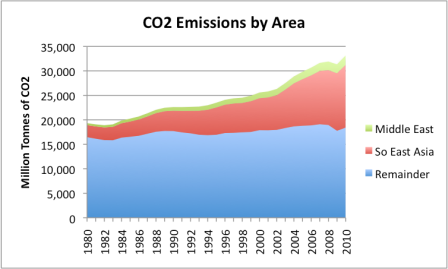
Graphic From "Our Finite World"
There's more than a little injustice in this statement, as CO2 content in the atmosphere is cumulative and the richest countries have contributed by far the most to the elevated levels, but ... it's also the case that China, which only recently passed the United States as the planet's #1 emitter, reportedly emitted 50% more than the US in 2011.  Recent growth in emissions are largely from developing regions that feature large numbers of people moving out of poverty, which most consider a good thing.  There are many more still in poverty - a bad thing.  I suggest this is further evidence that the goal of policy, including tax policy, should be scalable and affordable power.  Unless the carbon tax implemented offers that possibility, I would not consider it good policy.

The European Union has an Emissions Trading System (EU ETS), which is a carbon quota system.  In recent years, with recession (2009) and slow economic growth, there has been frequent criticism of the ETS as supplies have dropped.  Recently Australia committed to joining the EU ETS as a retreat from the more strident carbon tax their government introduced this year.  The ETS is now as likely to keep emissions from dropping as it is from capping emissions, as displayed by a very, very low value on carbon in the ETS.  It is problematic that a wealthy country can set policy with the position it can purchase quota from poorer areas of Europe because the ETS is regional.

A raw carbon tax has this inequity on a personal level.  Because lower income households spend a far greater share of income on energy, policies that inflate the costs of energy are regressive.

The Brookings Institution White Paper that Forbes reports on suggests introducing a carbon tax without some complimentary introduction of income support programs - which introduces other problems.  The circle of government action is to raise the cost of energy, and then introduce programs to pay poorer households enough to afford energy and food - and inevitably, due to the nature of politics and people, those programs expand beyond the households that need targeted assistance, or neglected (for examples of the former, see entries from OXFAMand Christian Science Monitor - for the latter the exchange noted here) - there's a real danger that the cost of compensating for energy taxes will exceed the revenue from the tax, and much of that compensation will be subsidizing fossil fuel consumption to compensate for taxing fossil fuels.

I would suggest that there's little evidence carbon taxation has accomplished anything in the longer term, as Europe is not reducing emissions at the rate the US is.  In the short term the accomplishments are as likely to be from the anti-emissions advertising value from introducing a tax to promote reduced consumption as to be from the minor consumption reduction economist would expect from a minor increase in pricing.  British Columbia's young carbon tax has been the subject of at least one study finding early success, without harm to the economy, but as one critic noted, respondents to a survey had generally not noticed any impact of the tax on consumption and had no knowledge of changed emissions - but they liked that there was a carbon tax.

The economics are questionable partially because of both the elasticity of demand, and the elasticity of supply.  On the demand side there is relatively little elasticity in the short term; in the longer term the elasticity is greater, probably due to households that can afford to spend on efficiency upgrades (causing concerns from the left on replacing "consumption with an investment").  The elasticity of demand amongst industrial users can be far greater in the short run (and for some businesses time-shifted loads may be pursued because of this); in the long run very few jurisdictions maintain high prices for industry long enough to figure that out; Germany exempts industry from the EEG (renewables) charge, the US average rates for electricity are $120/MWh for residential use, and $70 for industrial, and in Ontario the government introduced a program to lower rates for the largest users in 2011 (Class A global adjustment), and plans on introducing another.  Theoretically industry has a greater elasticity of demand - in reality some reduce their consumption to 0 if rates aren't competitive.

The price elasticity of demand is not very elastic, and industrial demand can be elastic, but it requires working with industry as they have the mobility to move to other jurisdictions.

The current glut in North American natural gas supplies, and improved oil outlook, were as predictable in 2012 as they were in 1974, when the Economist magazine ran an article at the height of the oil pricing during the oil crisis titled, "The Coming Glut of Energy."  The argument is as prices increase new energy supply will be produced to more than compensate for the depletion of existing resources, combined with the slight decrease in demand from higher rates.  Because demand is inelastic and reserves are known (but many difficult to get at), this is likely to remain the case for some time.  Peak oil theory doesn't necessarily contradict that - it's just a cycle of depleting resource at one price level leading to higher prices and another category of resource become economical to extract.

The United States is reducing emissions partly because of technological advances in extracting natural gas - a carbon tax would elevate consumer pricing without providing the price/purchase signal to develop more supply.

Unfortunately, it's unclear that other sources of energy can substitute for the role filled by fossil fuels.  As oil prices have spiked, we have not seen replacements of oil so much as the improved ability to extract oil elsewhere.  Tax policies make gasoline pricing far different in different countries, yet expensive countries aren't dominated by non-fossil fueled transportation.  It's unclear why a carbon tax would suddenly change that metric - thus the increasing skepticism that an energy revolution can be addressed by taxing fossil fuel.

That's not to indicate countries with more expensive gasoline don't have less gasoline consumption - but  most are also older, more densely populated, societies.

The wealth/power impact shows itself in societies in other ways.  I think Clay Shirky's popular TED talk's Israeli daycare section provides a very real possibility that the message of a regressive tax would be that poor people shouldn't use energy they can't afford, while people who can afford it should go ahead because they pay for it (from minute 7 through minute 10).
If you want somebody to do less of something, add a punishment and they'll do less of it.
Simple, straightforward, commonsensical -- also, largely untested.
...
If you pick your kid up more than 10 minutes late, we're going to add a 10 shekel fine to your bill.
Boom. No ifs, ands or buts.
And the minute they did that, the behavior in those daycare centers changed.
Late pick-ups went up every week for the next four weeks until they topped out at triple the pre-fine average, and then they fluctuated at between double and triple the pre-fine average for the life of the fine.
And you can see immediately what happened, right?
The fine broke the culture of the daycare center.
By adding a fine, what they did was communicate to the parents that their entire debt to the teachers had been discharged with the payment of 10 shekels, and that there was no residue of guilt or social concern that the parents owed the teachers.
While pricing carbon does have the support of many economist, that is unlikely to be as relevant as a social consensus that emissions are a bad thing.  That consensus exists, but it is muddied by the 'buts' 'ands', 'ifs' ... 'but' nothing is worse than nuclear, 'and' we can do something to solve it all (renewables); 'if' only either of those were true.

I don't see consensus building on meaningful action to address emissions coming from a carbon tax while most voters are suspect politicians would use a carbon tax to buy votes/fund frivolously selected objectives.  The suggestion in the Forbes article called for only 30% of the tax to be spent - and it would be spent politically - while the other 70% would pay down debt, as if the accumulation of debt had something to do with burning carbon!

James Hansen has a more socially conscious suggestion on the disposition of carbon tax revenues:
Disposition of the money collected from fossil fuel companies is thus the most critical matter. You can be certain that politicians and economists will come up with all sorts of suggestions about how they will cleverly use the money (investments in renewable energies, reduction of other taxes, etc.). Do not let them get away with it. The fee will only reach required levels if the money is going to the public. Let the motto be "100 percent or fight!"
The money collected from fossil fuel companies should be distributed electronically each month to bank accounts or debit cards of all legal residents. My suggestion is that each legal adult resident get an equal share, with families getting an added half share per child up to a maximum of two such half shares per family.
Hansen's suggestion eliminates many historical problems in growing government programs to compensate for a regressive carbon tax because while lower income people spend a greater share of their income on energy, they consume less energy.

If the mechanism of a carbon tax has utility in reducing emissions, this will reduce emissions.
I am not opposed to this form of a carbon tax.

The argument that it will not do enough to lower emissions significantly is probably valid - but the jump to there being something better that can be done in disbursing the revenues does not necessarily follow.

Some economic theory indicates other things would be more powerful than a carbon tax in designing lower impact societies and reducing fuel use.  Aldyen Donnelly argued, I think convincingly, that taxing the vehicle, or residence, should be more effective than taxing the fuel:
After one spends a little time calculating paybacks for different vehicle purchase options under different energy and vehicle price, tax, emission rating and purchase incentive scenarios, it becomes obvious — I believe — that any tax measures intended to change consumer energy use should focus on car purchase and annual re-registration, not fuel purchases.
Interestingly enough, if you go back to your Econ 300 micro and macro economic textbooks, you might discover that the economic theory we were taught a few decades ago actually suggest the same thing. The older textbooks (from back when I was young and Jesus was a baby too!), suggest that for a tax/price increase to effectively and efficiently impact consumer demand, the tax/price impact has to be revealed to/experienced by the consumer at a point of a “primary” consumption decision, not a “secondary” or derived consumption decision. Most fuel/energy purchases by non-industrial consumers are secondary or derived from their decisions to locate their home and the vehicles they buy. So even the traditional general economic theorists told us, so many years ago, that if we want to change energy demand in as economically efficient a fashion as possible, we likely would need to tax (to the extent this is the policy mechanism of choice) home and car purchases (primary capital expenditure decisions) and not energy/fuel purchases (secondary, variable, operating costs).
This is not an either or argument, but it is a prioritization.  A carbon tax is likely not the singularly best way to reduce emissions.  Aside from the point above, it's also clearly true that regulation itself is a good weapon, currently being used in regulating emissions from power plants, and automobiles.

In the end I would probably vote against a carbon tax, due to two very basic issues.

The first is costing externalities.  In Ontario's electricity sector history, pricing externalities was a major push in the 1990's, which somehow seems to have led to 7 nuclear reactors being shut down and a consequent surge in the use of coal - until the units were brought back into service.  The claim that a "full cost analysis" was guiding policy accompanied increased emissions.

The second issue is the disposition of the revenues, which are often lobbied to be spending on 'alternative' wind and solar energy.  But energy is not power, which is what people want.  The difference is the ability to do work over time as needed, instead of the ability to do work.  The generation technologies currently trending as 'green' are energy technologies - the additional systemic requirements to make them power technologies, dispatchable to meet demand, are not frequently, or adequately, addressed.  I refer to this as the second issue, but in reality the spending on energy, when power is required, has preceded the revenues throughout the debt-ridden west.

A tax to support the current renewables industry is as likely to prevent a drop in emissions as anything else.  The experience in Germany is instructive: while a nuclear phase-out policy was in effect from 2000, the strong performance of nuclear power plants in the following decade led to a grudging extension of their phase-out period, but with a new tax on nuclear fuel because it was felt non-carbon emitting nuclear had unfairly benefitted from the EU ETS price on carbon.  When the government reneged on the life extension, it left in the fuel tax.  Germany is left with more of a hope than a plan of reducing emissions.

More important than the carbon tax tool in the electricity sector is an understanding of the pros and cons of generation technologies, and the requisite market design that would encourage the development of technologies that can actually replace fossil fuels; this being a critical tactical shortcoming "at the interface of economics and engineering of electricity markets."

The option of pricing externalities, admittedly seen as 'first best' by a number of economists, is prevented by the difficulty in calculating that price, and in the gaming of existing electricity markets.  The most contentious aspect of a carbon tax is the disbursement of the revenues, and that should be a contentious issue.  There is disagreement over the extent to which a carbon tax will reduce emissions, but there needs to be another recognition that this 'first best' market option of addressing emissions is suggested in an environment where electricity markets are not functioning, in large part due to technologies politicians unwisely support as the 'winners' of the future.
Instead of pricing externalities, the far more prevalent government response has been targeted programs to promote specific alternatives to conventional electricity generation technologies. Justifications for such programs have generally begun with environmental concerns, but have often expanded to energy security, job creation, and driving down fossil fuel prices, generally without support of sound economic analysis. Such targeted programs also seem especially vulnerable to political manipulation.

If governments are to implement reasoned renewable generation policy, it will be critical to understand the costs and benefits of these technologies in the context of modern electricity systems. This requires developing sophisticated levelized cost estimates, and adjusting for both the market value of the power generated and the associated externalities, so they can be usefully compared across projects and technologies. Such adjustments are complex and frequently controversial. More research at the interface of the economics and engineering of electricity markets would be very valuable, particularly on the cost of intermittency, the benefits of end-use distributed generation, and the economic spillovers from learning-by-doing and network externalities. Progress on these questions would enhance renewable energy public policy and private decision making, particularly in a world where first-best, market-based options are greatly restricted.


Thursday, 15 November 2012

The Exhibition Turbine: An Icon for Ontario's Mazza Race

The Toronto Exhibition grounds are the appropriate site of a wind turbine that is frequently described as iconic.

What does this icon represent?

A review of the performance of Toronto's wind turbine indicates the financial numbers don't justify any respect being paid to the project. The turbine has a 600kW capacity - often reported as 750kW because of the capacity of parts of the turbine, but it seems it's actually 600kW due to the capacity of other parts of the turbine.  The initial costs were $1.8 million, the turbine became operational in January 2004, and the co-op owners reportedly received a dividend payment in January 2005 (4% of share value).

The only one they have ever received, and recent press reports indicate even it is forgotten.

The Globe and Mail reported that the turbine performed poorly in 2006, 2007 and 2008; The Toronto Star reported production of 780MWh in 2008, 1064MWh in 2009 and 927MWh in 2010.

In March 2011 the turbine broke down, and it would not come back until parts costing $200,000 were found and installed at the start of May. The output in 2011 probably dropped below the 1000MWh estimate, which makes it likely that since 2005 the 1000MWh level was achieved only in 2009.


It's notable that during the period in 2011 when the turbine was awaiting it's bearings, a video was released where the maintenance is heralded and the performance is sited as being excellent for the past 4 or 5 years.

The turbine broke down again in August 2012 and continues to be inoperable.  Not surprisingly, a glowing article appeared in the absence of a functioning turbine - financed by TD Bank and Suncor and posted on the Huffington Post: The Butterfly Effect: How A Single Wind Turbine Led To A Renewable Energy Revolution In Ontario:
"The folks that formed TREC [Toronto Renewable Energy Cooperative] really wanted a site that would act as a demonstration, an icon if you will, for the green energy movement." 
...

  • TREC and Windshare were also the starting point for an emerging renewable energy movement. People who were involved moved on and created many more community-minded renewable energy initiatives.
  • The Ontario Sustainable Energy Association, an organization formed to implement community sustainable energy projects across Ontario;
  • The Community Power Fund ...
  • SolarShare...
  • And ultimately the Green Energy Act, Ontario's German-inspired feed-in tariff was passed leading to thousands of wind, solar, hydro and biofuels projects being developed in Ontario.
So the project is a total dud financially, but the participants in the project are now highly influential due to their involvement.  Success is in the influencing of political policy.  TREC's Executive Director, Judith Lipp, has emphasized the involvement of TREC leading to Ontario's Feed-In Tariff Program (FIT) and Green Energy Act (GEA).  More recently, she has noted a broader purpose to TREC's activities:
...what we’re transitioning to is a decentralized electricity system, but there’s lots of people who don’t understand what we’re doing; they turn the lights on but they don’t really want to engage with how it is that we keep those lights on and the impact that keeping those lights on has on the environment as well as the other social aspects of the matter. So the challenge is navigating the system that is geared towards large players...
It's notable that the measurement of success seems to be in moving away from some incumbent system - in Ontario's case presumably public power, and up until Bob Rae's government, public power at cost.

While the failure of the Exhibition wind turbine as an electricity generating device is seldom mentioned, the feed-in tariffs, and the Green Energy Act the iconic project is credited with developing did catch the attention of Ontario's Auditor-General.  One aspect of the 2011 Annual Report is summarized:
(TORONTO) Billions of dollars of new wind and solar power projects were approved without many of the usual planning, regulatory, and oversight processes, Auditor General Jim McCarter says in his 2011 Annual Report.
“While this helped these projects get off the ground quickly, their high cost will add significantly to ratepayers’ electricity bills in the future,” McCarter said today on release of the Report.
“Going forward, it will be critical for the Ministry of Energy and the Ontario Power Authority (OPA) to conduct an objective cost-benefit assessment of the progress made to date to provide government decision-makers with the information they need to strike an appropriate balance between the promotion of green energy and the price of electricity in Ontario,” McCarter added.
The exhibition turbine has been iconic - of the lack of interest in the financial analysis on the electricity sector - but also iconic in demonstrating there are not measurements that could determine what is a failure in transitioning from an unacceptable past to a glorious future.

The lack of interest in financial analysis also figured prominently in another report by Ontario's Auditor General, delivered in March:
(TORONTO) The Ontario government has given Ornge more than $700 million since 2006 to provide ambulance service in the province without sufficiently monitoring how well Ornge was doing its job or whether it was following appropriate public-sector business practices, Auditor General Jim McCarter said today on the release of a special report entitled Ornge Air Ambulance and Related Services
When the disgraced head of Ornge finally appeared before a legislative committee in July, his opening statement also noted a greater purpose of displacing an incumbent system:
I believed and I still believe deeply in what we were doing. For me, Ornge was never about personal enrichment or personal gain. It was about the vital and urgent necessity to transform an antiquated and dysfunctional air ambulance system that everyone knew did not serve the interests of Ontario residents......not everyone agreed with these changes, and you have heard from some of these people. But the changes that were implemented and continue today are paying dividends.
The transcript indicates Mr. Mazza used some form of the term "sustainability" 7 times during his testimony that day.  Disregarding the overwhelming evidence of waste, and fiscal irresponsibility, MR. Mazza maintained the bedrock faith that an unsustainable past justified his actions towards a better future; actions that are immune from being judged.

People that tend to think tactically, like auditors, would find that troubling.

I find it troubling for reasons well beyond the financial.
  • People do not know the future - hopefully they make their future;
  • Privatizing services does not remove the need to manage the operations: a push to privatization based on creating a market is defensible, but a push to privatization based on the government's inability to manage the delivery of a service simply leads to a government incapable of managing the privatization;
  • When there are no measurements of success, success is not based on competence;
  • When success is not based on competence, it is based on personality and preference...

In April the government established Ontario’s Clean Energy Task Force, "to help broaden the Province’s energy focus."  Predictably, the 14 greenest energy folks found to populate that 'clean' body are similar in colour.  With competence in the generation and delivery of electricity unimportant, the selection criteria is contempt of the past, feigned knowledge of the future, and overall display of the characteristics of the Mazza race.
----


Friday, 9 November 2012

Electricity Data and Narrative

Comment on the role of data in a society driven by narrative.

A recent post at Tom Adams Energy gave an Ontariocentric call for data reporting in a Canadian jurisdiction along the lines of the the United States' Energy Information Administration (EIA).  Mr. Adams may have been unaware that Dr. Michal C. Moore of the The School of Public Policy at the University of Calgary authored a paper earlier this year with an overview of a national structure that might fill the role of the national EIA structure in the US.  Dr. Moore's paper saw a central data organization, namely Statistics Canada, collecting the data that would be manipulated/interpretted by an independent organization.

The issue I have with the paper is it assumed Statistics Canada excelled at collecting data.  That may be true, but I found reason to be skeptical..   The uproar over the change to the long-form census, which somehow entered the mainstream, reflected, in my opinion, the often conflicting goals of maintaining the same processes, and standards, in data collection to ensure data integrity between census years, and the desire to collect the best data possible - which is now frequently in databases throughout the government to be collected through the data mining of critical systems, and not intermittent surveying outside of those systems.  As an example, most federal funding for provincial programming is not based on census figures, but the ongoing population estimates (and census counts are adjusted based on the population estimates).


Recently Statistics Canada made freely available its CANSIM databases.  My experience with that data increased my opinion that Statistics Canada is less about data and more about interpreting data - that may not be a bad thing, but it is certainly a bad thing in terms of the thesis that Statistics Canada would provide the data and expert bodies at some new multi-governmental agency, the University of Calgary, or Tom Adams Energy, would provide the context.

One example Mr. Adams provided of "black holes in the official information currently available" is "average commercial rates in any year."    CANSIM Table 329-0050 provides that type of data; it is decreased in value as it is presented not in a monetary value per unit ($/MWh), or even a monetary value rationalized to a base year (ie. all figures adjusted to 2005 dollars), but the data is presented in terms of the percentage of 1997 price, with the series starting in 1981 but terminating in 2011).    This makes the data limited for comparing between jurisdictions.  Nonetheless, data is never perfect, so one works with what is available unless they want to experience the drudgery of data collection.

The data is still of utility in comparing the trend in non-residential electricity pricing to other trends, such as the ability of the provincial government to balance it's books.  On the topic, another article that caught my attention today, as it was flagged by Ontario Green Party Leader Mike Schreiner was "Diagnosing Ontario’s Christmas Pony Syndrome."  I have a very different opinion on the debt from the old Ontario Hydro days than the writer of that piece, but this paragraph inspired me:
Ontario was still addicted to this fiscal confection when Mike Harris added another thick layer of alluring icing in 1995. He ran for premier on a public promise to freeze power rates for his entire term – without first daring to look at Hydro’s books. He won huge, and kept his word. Four years later our provincial utility effectively became bankrupt under the weight of $38 billion in publicly-owed debt.
Graphing the CANSIM Table  329-0050 data along with the annual budget deficits in Ontario, it doesn't appear freezing rates had any detrimental impact on the finances of the government (it also shows the price freeze occurred prior to 1995's election).

Government finances improved consistently throughout the period electricity rates were frozen despite the increasing the accounting of debt on the government's electricity unit.  It gives reason to question the current PC Leader on exactly what he means by treating electricity policy as economic policy, and not as social policy.  It must be noted that as of January 1, 2011, the government introduced a new pricing scheme for large users (industrial or, sadly, educational) that would show a drastic drop in rates for the "over 5000kW" group.

In the early 1990's the fascination with running the government as a business took hold (this is the time Ontario Realty Corporation was formed - a 2 decade long flop of an attempt at treating government facilities as real estate assets).  It was probably somewhat of a change in perspective to break out debt into different boxes.  There is no real differentiation between OPG, Hydro One, ORC, and Ontario government debt (check the debt ratings), and there was no real differentiation between the old Ontario Hydro debt and Ontario government debt.  The assumption that Ontario Hydro debt had any negative impact on Ontario's finances is unsubstantiated.  Certainly in the immediate period following Darlington becoming fully operational, the opposite may have been the case.

There was no distinct "Ontario Hydro" that could go bankrupt, while economic growth appears to have cancelled out the overall fiscal impact of freezing electricity rates.

At the rates the government pays in interest charges now, the enormous sounding $38 billion would require annual debt payments of about $1.7 billion of which the government already collects ~$1 billion as a debt retirement charge (which hasn't been used to retire debt for years, but....), while selling the output from the public generator (OPG) for ~$2 billion a year more than the public generator is paid.   For that debt we have the generating assets of OPG and the transmission and distribution assets of Hydro One.

The $38 billion aside, it's not clear that increasing the charges to industrial customers isn't entirely counterproductive.

Another interesting combination of data: CANSIM with the IESO's data on monthly consumption for wholesale customers (Table 3.3.3 here has data since market opening in May 2002).  Wholesale demand dropped steadily from late in 2004 to mid-2008, at which point it dropped off a cliff before stabilizing in mid-2009.  In May 2002 the price for the largest non-residential customers was about the same as it was in 1997, and therefore 1992.
Today it still is - and the government is still fighting to bring large industrial users back to Ontario with further price offers driving the price well below the frozen rates of the Harris years.

There is enough data to note the reality that jurisdictions have very little ability to increase pricing to industrial users without losing them,  The reality would seem to be that calls for higher electricity rates will increasingly mean higher rates for primarily residential users.

Data is available to show how much more onerous increasing the costs of energy are on low income households which obviously spend a much greater share of disposable income on energy.

I could dig some of it out, but "shit travels downhill" is one common narrative I won't be trying to disprove.


Friday, 2 November 2012

ON latest stats; Reinforced lessons on policy errors

The beginning of the month can be a busy time querying the stats for regular reporting, and to evaluate the messages contained therein.  Recently there's also broad coverage on Ontario's electricity sector in the mainstream media that touches on many subjects I've written on previously.   The most recent figures reinforce some old messages related to the news of the day.


Increased Wind and Increased Coal

While the final days of the month led to coal having it's first decline in 8 weeks, it ended the month with an increase to 240 GWh, from 105 GWh the previous October, which was enough to move coal-fired generation in 2012 up on 2011 on a comparable year-to-date basis.
The jump in coal use did not surprise me as it accompanied a growth in wind generation of 50% from October 2011.  Gas-fired generation, meanwhile, fell 36% from October 2011.
Combined, this indicates emissions can fall through better supply management in allowing the most appropriate generation to be utilized; given Ontario's high baseload mix (hydro output was up 4%, nuclear 5%), and increased intermittent supply from renewables, there are situations when that probably is coal.
As renewable capacity increases, so too do the situations when the flexibility provided by the peaking depth of coal is desirable (see At the end of the IESO18-month outlook).

High Winds Make Wind Cheaper than Natural Gas Generation

My global adjustment estimates are built by generator, and for natural gas generators the average price I've estimated for October is ~$140/MWh, up from $83 in July.  This is because the more that gets generated, the cheaper the rate becomes.  October's 1.2 TWh estimate of gas-fired generation is my lowest monthly total for the fuel in 32 months.  Under a third of that 1.2 TWh was generated at the Greenfield, Halton Hills, Portlands, Goreway or St.Clair CGS sites - relatively recent builds with Net Revenue Requirement contracts likely over $15000 per MW month (reference).

A recent post demonstrated the levelized unit energy cost (LUEC) from the Oakville Generating Station, now planned for Bath, under different capacity factors - or utilization rates.  October provided a glimpse of what I'll call the Pembina scenario in that post, with the cumulative capacity factor for previously cited sites at 13.5% leading to a LUEC of $177/MWh despite low natural gas prices.

The increased presence of intermittent generation drives down the capacity factor of gas (and coal) units, and therefore drives up the price.

Negative Pricing and Exports Continue

The month started with the implementation of a rule to prevent exports at negative prices (see 3rd paragraph here).  By the end of the month the rule appears to have been unhelpful.
While the actual price exports are sold at is not available (and complicated by the involvement of multiple markets), monthly totals don't vary much from the value at the Hourly Ontario Energy Price (HOEP).  The IESO's figures for exports, and the HOEP, indicate about $3 million was paid to export electricity during negatively priced hours.


Originally appeared in "At Any Price ..."
It is notable that the most severe pricing events occurred towards the end of the month.  Analysis of Ontario's generation needs, treating renewables as negative load (here), shows that this is a time of year where versatility will be increasingly important in Ontario's generators.  The lack of versatility must result in excess generation - or curtailment of the intermittent sources that corrupt the load profile.

It could be seen as courageous that the IESO introduced this rule entering such a challenging period, but in it's early testing, the rule appears to be a failure.


The Global Adjustment

The past 3 months the month-end estimate of the global adjustment I've made has been more accurate than the second estimate from the IESO.  They'll need to revise upward their estimate of $542 million by close to 10% if the final ends close to my estimate of  $585 million. (previous article on the diffence)

The weighted average HOEP is only around $22.26 for October, so even a 10% hike on the IESO's new estimated Class B rate, of $52.02 will only push the total commodity charge to the regulated price plans most Ontarians would know, which is around $80/MWh (my supply cost estimates are here - for more on the global adjustment see here).

Transfer of Wealth From Public Generator to Public Generators

Tom Adams' Green Zombies , in the Financial Post, provided an overview of  Premier McGuinty's electricity policy history.   I recently tweeted a reference to an article I'd written during the summer of 2011, and Mr. Adam's article was one more reason to return my attention to Duncan's Grow-Op is Stealing Hydro, in which I included a 2004 quote from Mr. Duncan indicating, to me (with hindsight) the planned strangulation of public power and transfer of wealth to private operators:
OPG's nuclear and baseload hydroelectric assets would be regulated by the Ontario Energy Board...Fixed prices for a large part of the energy consumed in the province would keep the overall blended price for electricity relatively stable.
In the article I provided a graphical overview indicating the 'fixed' pricing at OPG meant their average rate was stable while overall rates escalated in Ontario.  With the database I now maintain I can provide better estimates - with a breakdown separating Bruce Nuclear and OPG from all other generation (no solar is included, and the figures do not include the share of OPA's CDM programs also included in the global adjustment).

OPG rates actually look to be falling back towards $50/MWh.  This is due to the depressed HOEP price impacting their our unregulated hydroelectric assets, which is essentially the only generation in the province the government has not provided a contracted rate to.
The rates for OPG have been, essentially, 'fixed' for a very long time.

Bruce Power average rates likely fell, on a 12-month moving average basis, as Bruce A units, contracted at a higher rate than Bruce B units, were removed from service for life-extension projects.  Recently 3 of the 4 Bruce A units, including 2 newly refurbished units operating for the first time in a 14 years, are operating so the Bruce Power pricing will now increase.
Obviously the most expensive generation is neither public not nuclear.  The annual price of all other power is over $100/MWh.  It is the most volatile pricing precisely because it moves up on low generating levels (the shoulder seasons), and down on high generating levels (particularly summer heat).

Mr. Duncan is the architect of a system designed to pay the public generator far less than their output is resold at, in order to fund paying private generators far more.

The Debt Retirement Charge

The Ontario Electricity Financial Corporation Annual Report for 2011-2012 has not been presented.
This is the first time since 2002-03 when the Annual report was not presented prior to November 1st.  At that time a fall election had delayed the sitting of the legislature; generally the annual reports are filed while the legislature is sitting, but that was not the case when the Annual Report for 2010-2011 was hurried out in the summer of 2011 with the appearance of providing a defense for the governing Liberal Party under attack for continuing to apply the Debt Retirement Charge (DRC) after the Residual Stranded Debt (RSD) that he PC's claimed should have been retired.

When the government did provide information on the Residual Stranded Debt, beneath the words lay facts that showed the last full year before the Liberals took power, the RSD stood at $7.5 billion (March 31, 2003).  After 8 years collecting approximately $1 billion a year from the DRC, it still stood at $5.8 billion (March 31, 2011), and had been rising in recent years.

Encouragingly, the government projected the RSD would fall rapidly in the years ending March 31, 2012 and 2013.  Discouragingly, it seems unlikely that other sources will suddenly provide sufficient funds to halt the pilfering of the DRC as the profits at Hydro One did not change significantly from the prior year, nor did the profits at other distribution companies, and OPG is kept in the position of having essentially no profits (as discussed above).
Most discouragingly, the projection is made by the Finance Department - the Minister of Finance being the architect of the continued debt, Dwight Duncan.

All of which belongs in a monthly review for October only to point out the 2011-12 Annual report of the OEFC is long past due.

The likelihood is that the ~$1 billion in DRC received will not go to retiring debt.

The Gas Plant Cancellation Costs

The big news in the mainstream media continues to be various estimates of the cost to Ontario taxpayers, and/or ratepayers.  Some reports (such as this), put the cost in the area of $1 billion.

We weren't sure exactly how they'd throw $1 billion away, but we did know it happens every year.