Friday, 23 May 2014

Not Honouring Ontarians: Wynne's Green Energy Contracts

I sent some numbers to Parker Gallant the other day, along with a question on political donations, and within days the prolific Mr. Gallant produced, "Constraining wind power in Ontario: Making your head spin..."

Before I introduce the figures behind that column, I'll provide some background on the Ontario Liberal party's approach to contracts.

Another election campaign in Ontario is underway, and some of it is a repeat of the previous election campaign; the Progressive Conservatives (PC) claiming they can better control costs and the incumbent Liberals claiming the PCs will renege on contracts. Contracts bind participants to obligations: the Liberal government has failed to protect the people's side of green energy contracts a couple of times since 2011's election - where there is a benefit to their party to do so.

First, there was the Korean Consortium (KC, aka Samsung). In April  2013 I wrote on how they weren't meeting contract requirements, or investing significant amounts of their own funds.  The KC deal, which PC leader Tim Hudak had stated, in 2011, he would kill, was re-written 2 months after I pointed out the Koreans weren't honouring the contract, but not killed.

The government claimed savings of $3.7 billion - money that they'd campaigned on not being possible to save in 2011.  Worse, the contract renegotiated - because the proponent had not kept it's initial contract commitments - guaranteed the KC a base price of 29.5 cents per kWh for the still contracted solar capacity; that's a price far exceeding what it would cost for, as one example, the public generator to provide grid-scale solar capacity.

So it looks like I saved Ontario $3.7 billion, but I could have saved far more if the Liberals had the decency to cancel a contract because contract obligations were not fulfilled by the proponent - instead of providing expensive plums to the negligent proponents in order to avoid having Tim Hudak be shown to be correct.


Parker's post today relates to a cost issue I'd written on a year before outing the Samsung disinterest in meeting contract terms. I got some technicalities wrong in "Billions at Stake In Feed-In Tariff Contract Fine Print" - like the contracts in question pre-dated the feed-in tariff program - but the gist of the article was correct. A collection of generators (pre-FIT) were not contractually obligated to be paid for potential generation the grid was unable to accept, and a separate collection of potential generators (FIT) were in danger of not getting their projects built for a variety of reasons, including the ability to finance construction being partially dependent on a government willing to ignore enforcing the original contract terms.

The point was moot until the system operator had the ability to curtail that output, which occurred in September 2013. Generators who had no claim on being paid for curtailments had been appealing to the Ontario Energy Board to save them from their contracts, but the Wynne government ended that by simply agreeing to pay them for the supply the grid couldn't accept (in March).

I wrote on this in December's Big Thunder is a Big Mistake, and it's not the only one (comments are a useful read too), which brings us to Parker Gallant's article today.  I ran the queries I'd developed for the Big Thunder article, and found the biggest beneficiaries of Wynne's decision to pay generators for curtailed supply:

  1. Enbridge - the energy giant, with the big winter gas bills
  2. Brookfield - also the main private-sector owner/operator of private hydro contracts in Ontario
  3. TransAlta - another energy giant, particularly notable for its coal-fired generation
  4. IPC/GDF Suez - the company  run by former President of both provincial and federal Liberal parties

Parker collected some political contribution data in building his article (along with other Enbrige news); the numbers I'd sent him are shared in this google speadsheet.

Constraining wind power in Ontario: Making your head spin or, how Ontario’s energy sector is regulated | Wind Concerns Ontario
Enbridge Gas Distribution recently received the blessing of the Ontario Energy Board (OEB) for a 40% hike in what they charge Ontario’s consumers for distributing natural gas, claiming, because of the high demand during a cold winter they were forced to purchase it at a high market price. The OEB granted the approval despite many objections by various interested parties who pointed out that Union Gas had requested a smaller increase.
This note was in the OEB’s approval: “This means that Enbridge plans for lower storage deliverability requirements and transportation capacity” requiring gas purchases at higher spot prices on the open market. One wonders why Enbridge is not required to maintain a larger storage capacity, which would have allowed them more prudence in purchasing the supply of gas, but that is presumably a question for the OEB to ask!
While the OEB was weighing their decision, another arm of Enbridge was constraining their production of wind-generated electricity. That was to allow the Independent Electricity System Operator (IESO) to protect the grid and prevent blackouts or brownouts by requesting constraint.
Constraining wind power—and paying for it—started September 11, 2013. Since then Enbridge has been paid for notproducing about 83,500 megawatt hours (MWh), which should have generated close to $9 million.
Enbridge was not alone: Brookfield didn’t produce over 29,000 MWh and IPC/GDF Suez (where the CEO is Mike Crawley) didn’t produce 12,800 MWh, and TransAlta didn’t produce 17,100 MWh. In total about 161,000 MWh were constrained since IESO started paying wind developers—that means ratepayers picked up the $16 million cost. And that cost doesn’t include what ratepayers pay for remote meteorological stations to ensure wind developers don’t lie about what they may have produced.
Interestingly enough if one checks out Elections Ontario to determine what those wind developers contributed to the three major political parties in 2010, 2011 and 2012, you find that the NDP received nothing, the Ontario PC party received $1,080 from Enbridge and the Ontario Liberal Party or OLP received $8,000 from Enbridge, $14,840 from Brookfield and nothing from the rest. The CEO of IPC did donate a total of $555 to the OLP.
The wind power lobby organization Canadian Wind Energy Association (CanWEA) contributed $16,620 to the OLP over the last three years and zero to the NDP or the Ontario PC party. I wonder why?
This situation is a win-win for some of the parties involved, but a hit to the pocketbook of the average ratepayer.


Tuesday, 13 May 2014

Hudak's numbers and the MSM's biased suspicion

I understand fact-checking political statements but let's be fair...

I'd read Maclean's "Infographic: Where the jobs are in Ontario", and was struck by a couple of things in the opening paragraph:
Ontario PC leader Tim Hudak is staking his electoral changes [chances] on a promise to create one million new jobs if elected, even while cutting 100,000 public sector positions. That may be a challenge since the provincial economy has created just 667,000 new jobs since the Liberals came into power in 2003. Nearly half of those jobs have been in the public sector.
Two things:
  1. what is Hudak staking his electoral chances on? 
  2. what message might the press be broadcasting? 
I think THE message here is that for a decade every time somebody got a job in the private sector another person was hired in the public sector. I'm going to discount the possibility those private sector jobs paid spectacularly well, and assume this is a big part of the $130 billion increase in Ontario's debt during the same period.
That would relate to another one of Hudak's campaign nuggets - one pilloried in today's Globe and Mail.  Formerly Canada's National newspaper, the Globe's editorial board wasted pulp on the "Can Tim Hudak win election by 100,000 job cuts?" editorial.  

The Globe's editors find it inconceivable. that 100,000 jobs could be eliminated after nearly half of 667,000 jobs were added?

Most people find $290 billion of debt inconceivable.

Let's return to the start of the Mclean's article; 'Hudak is staking his electoral changes on a promise to create one million new jobs if elected..."

Consider this [emphasis added]:
Over 50,000 jobs in the next three years are expected to result from implementation of the Green Energy Act.   -News Release, May 14, 2009
The Ontario government is investing $34 billion over two years to stimulate the economy. This timely and targeted investment includes $32.5 billion in infrastructure spending and nearly $700 million in additional funding for skills training. This will preserve or create more than 300,000 jobs over the next two years to support Ontario's families and communities.   -Ontario Budget 2009: News Release, March 6, 2009
It is estimated that, within 10 years, the improvement in Ontario’s tax competitiveness will lead to $47 billion in new investment and 591,000 net new jobs and will raise annual incomes by up to 8.8 per cent.10  ONTARIO’S TAX PLAN FOR JOBS AND GROWTH, Nov. 2009

So what damage is done to Ontario's Liberal Party from the promises of close to 1 million jobs during 2009?

Friday, 9 May 2014

Ontario's electricity supply outlook is the worst in North America

Early last December Ontario’s Liberal government released their latest “Long-Term Energy Plan” (LTEP). The document indicated Ontario currently has sufficient capacity to meet “North American reliability standards,” unlike a decade earlier when the Liberals came to power in Ontario.
In 2004, Ontario’s supply outlook was not sufficient to meet North American reliability standards. Today’s margins are above required levels. This reflects the strong supply of electricity the province is enjoying. Ontario has gone from a deficit of 3,800 MW in 2003 to a comfortable surplus in 2013.

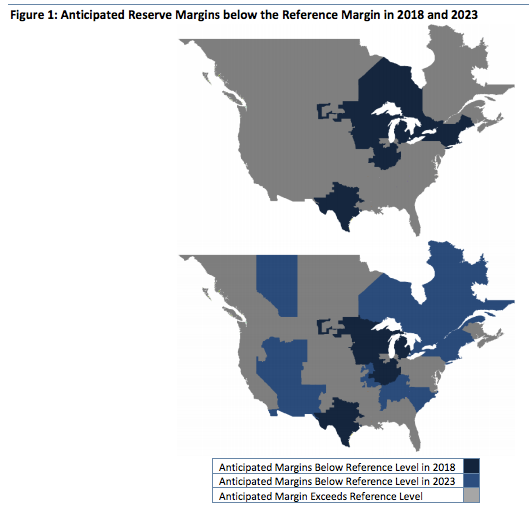
NERC 2013 Long-Term Reliability Assessment, page 5
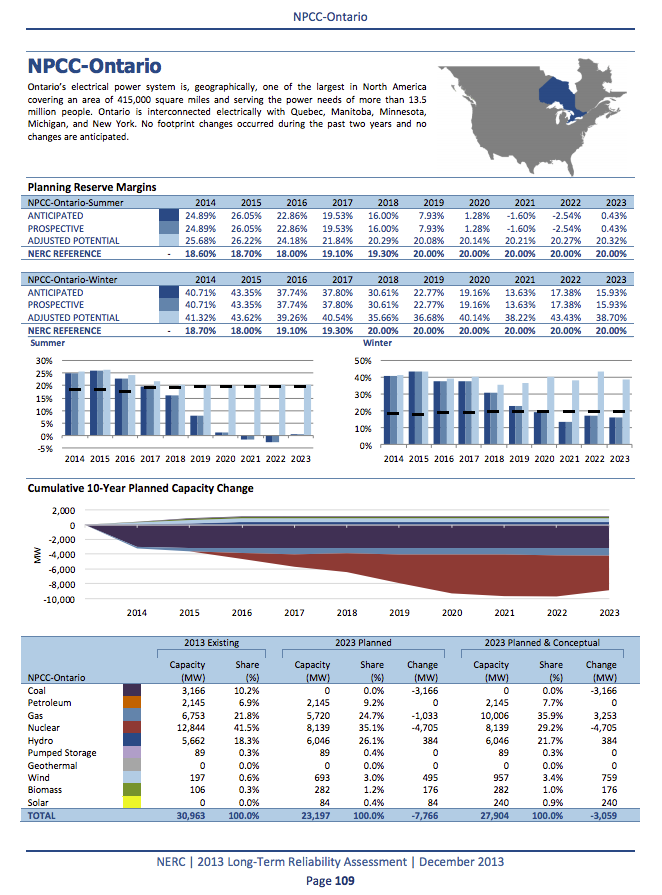
North American reliability standards are the domain of the North American Electric Reliability Corporation (NERC). Within a week of the release on the LTEP in Ontario,NERC released its 2013 Long-Term Reliability Assessment, which noted, “In the summer season of 2018, the NPCC-Ontario Anticipated Margin falls below the NERC Reference Margin Level.”

4 years is a very short time for developing reliable supply.

Ontario supply was tight in 2003, but work was underway for more; ~1250MW of capacity returned to service by the end of 2003, ~1400MW in 2004, and another 500MW in 2005. [1]

The firm supply Ontario added from 2003-2005 is different than the capacity additions planned for the next few years, which is primarily from variable intermittent energy sources (vRES); wind and solar.

OPA Slide from "Generation and Conservation Tabulations..."
The numbers shown by NERC won’t surprise the Ontario Power Authority (OPA), or Ontario’s system operator (the IESO).

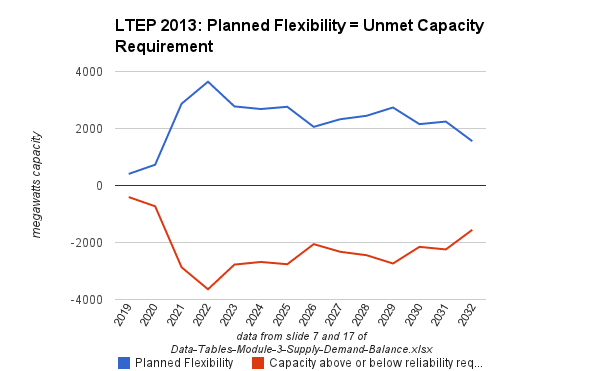
The OPA’s material demonstrating the figures behind Ontario’s LTEP also shows the capacity shortfall starting in 2019 and building to over 3,600 MW in 2022.

The plan is for Ontario to be in the same supply position a decade ahead of now as it was a decade behind.

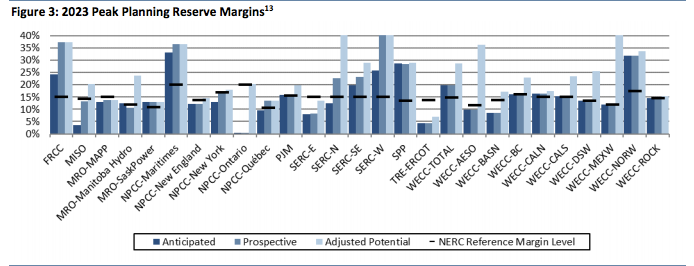
NERC’s forecast shows that, in two out of 3 models, Ontario is planned to have the lowest reserve margins in North America.
NERC’s models do offer Ontario a glimmer of hope in the “adjusted potential” scenario, which accounts for “the inclusion of less-certain resources, such as Conceptual capacity and nonfirm capacity transactions.” Problematically, NERC failed to anticipate the wide capacity scares of the past, “polar vortex”, winter. The trend for the near future is likely to treat “conceptual capacity and nonfirm capacity transactions” with a great deal of skepticism.
image+(16).png
From my recent "LTEP 2013: An unfinished plan"
The risks of new market tools and demand-side management advances not providing sufficient capacity are simply one looming problem for Ontario’s capacity requirements. The Long-Term Energy Plan (LTEP) released in December 2013 brushed off the reserve requirement issue by using a correcting entry in the generation column, calling it “planned flexibility.”

The plan also expected a great deal from existing nuclear power stations.

The LTEP’s commitment to nuclear is lukewarm, and possibly impractical.
Ontario plans to refurbish units at the Darlington and Bruce Generating Stations. The refurbishment has the potential to renew 8,500 MW over 16 years. The province will proceed with caution to ensure both flexibility and ongoing value for Ontario ratepayers. Darlington and Bruce plan to begin refurbishing one unit each in 2016. Final commitments on subsequent refurbishments will take into account the performance of the initial refurbishments with respect to budget and schedule by establishing appropriate off-ramps.
That sounds reasonable, but the LTEP’s refurbishment schedule may stack the deck against reliable nuclear operations; it shows Bruce B’s reactors operating for about 40 years prior to refurbishment. One expert analysis notes these units were predicted to need refurbishment due to components with a life of, “210,000 Equivalent Full Power Hours (EFPH) or 30 years at an 80 percent capacity factor.” Units at Bruce B will approach 300,000 EFPH if both the LTEP’s refurbishment schedule and its anticipated generation from nuclear power plants are met.

The Wynne government’s long-term energy plan promises only tepid commitments to maintaining the firm generation it currently possesses, and results in the continent’s worst forecast for meeting reserve requirements in the coming years despite projecting demand growth to be among the slowest on the continent.


Endnotes

1. most of this capacity was nuclear; Bruce units 3 (2004) and 4 (2003), and Pickering units 4 (2003) and 1 (2005). Bright Beach (natural gas) also entered service in 2004.

2. The section of NERC's 2013 Long-Term Reliability Assessment specifically for Ontario begins, with this graphic, on page 109:


Wednesday, 7 May 2014

Zombie docs living in Ontario's zombie budget

The Ontario government delivered its budget on May 1st; the NDP announced they would not be supporting the government any longer on May 2nd, and the Premier threw in the towel putting Ontario into an election campaign.
The budget may never have been intended to be practical, but created solely to be a "zombie" document to reference during a campaign.
bad data illustration from page 134 of the 2014 Ontario Budget

I was surprised to see the budget repeated a graphic based on the same Hydro-Quebec (HQ) report I debunked in picking apart Environmental Defence's lousy report on Ontario Energy Costs.

The HQ report graphs values of 12.475 cents/kilowatt hour (kWh) on a 1000kWh bill) for Toronto [1] and 12.391 cents/kWh for Ottawa.

I don't mean to criticize the HQ report, although those are the two figures I know best in it and they are wrong.

I do mean to criticize the former Ontario government that cynically included numbers from HQ in an Ontario budget.  While I'm at it, I'll criticize their base too - apparently the urban voters favouring the Liberal party can't figure out what they pay for electricity, and that it is not what their government tells them Quebec's public electricity company reports they are paying.


One more stab at showing HQ estimates are low.

image of TH interactive sample bill
The sample bill from the Toronto Hydro website shows pricing of $323.83 for 2000kWh of consumption over a 2 month period.

That works out as 1000kWh a month (as in the HQ study).
It works out as 16.2 cents/kWh (unlike the HQ study) - if you ignore that the Ontario Clean Energy Benefit discount is paid by taxes (or additional government debt).  Without the OCEB the bill is over 17.5 cents/kWh on consumption of 1000kWh.

This was the Ottawa Hydro sample bill [3]
The Ottawa Hydro sample bill is less coherent, but appears to be claiming using 800kWh a month would result in a bill of $127.16; an average of 15.895 cents/kWh.[3] That's 28% higher than the HQ study claims the Ottawa pricing was a year earlier.

Quite the inflation ... or just bad data in HQ's study.

I did note on these sample bills that neither Toronto's nor Ottawa's distribution companies have complied with Measurement Canada guidelines/rules on charging by metered readings; both still show an "adjusted" - meaning increased - consumption figure using a loss adjustment. [2]

That belongs in the delivery charge and the transition should be made 5 years ago (I think the Ontario Energy Board anticipates it will be made within a year).

Ottawa Hydro's sample bill is particularly entertaining as not only do they still tack on the tacky line-loss adjustment, but they show the 800kWh of metered consumption as being comprised of 466.11kWh Off-peak, 621.48 kWh mid-peak and 569.69 kWh on-peak.

Interesting math.

No wonder nobody pays much attention to the details on their bills - but I'm not sure they should continue to show the same disinterest in their ballots.


ENDNOTES

1. What is actually shown is $124.75 for a bill based on consumption of 1000kWh, which works out as $124.75/MWh or 12.475 cents/kWh

2.  My local distribution company (Hydro One) did cease the line-loss adjustment last year; the online hourly data they make available for download adjusted all figures back to the installation of my smart meter.

3. Soon after I wrote this, the sample bill on the Ottaws Hydro site was corrected - sort of.  The TOU rates now add up to 800kWh (if their billings are the same as my Ontario Hydro bill once was, they'd up to the "adjusted consumption" shown in the meter section of the bill, but it's now close).
When they fixed the figures the cost rose to $130.11, so it works out to 16.26 cents/kWh - essentially the same as the Toronto Hydro sample bill's average.

Sunday, 4 May 2014

Wither the I in the IESO: politics hit May's global adjustment estimate

It's called the IESO, for Independent Electricity System Operator, but it hasn't looked independent for some time, and never less so than this week.

On the afternoon of April 30th the IESO posted its "2nd Estimate" for April's Class B Global Adjustment (GAM) rates, and the "1st Estimate" for May's.  I noted a month ago how bad April's 1st estimate was; it was honestly bad.
May's first estimate of the GAM looks to be the opposite - dishonestly alright - and that's indicative of a bigger problem.

The budget released May 1st restated the Liberal government's desire to, "consolidate two electricity agencies — Ontario Power Authority (OPA) and the Independent Electricity System Operator (IESO)." A former bill to merge the two entities was introduced in 2012, but died when former Premier McGuinty prorogued the legislature and fled to Harvard. With the omnipresent threat of consolidation, there is not only the danger of a power struggle within Ontario's several electricity sector bureaucracies, but a danger that struggle will be won by sycophancy, and not capability nor competence.

The 1st Estimate

The public is not privy to the actual numbers used in calculating global adjustment estimates, but we do know the final figures, and the process is public.
pg 37 of  Market Manual 5, Part 5.5: Physical Markets Settlement Statements


Assuming consumption doesn't change a whole lot from month to month, we can use the rates ($/MWh) to estimate the 1st estimates. [1]

As an example:
last September the first estimate was a record $87.18/MWh.  That was close to the $62.45/MWh final GAM for August plus the difference between that final GA for August and the low 1st estimate ($40.13).  Ontario's record commodity rate, comprised of the Hourly Ontario Energy Price (HOEP) and the GAM, is $95.13(Feb. 2014), so the $87+ first estimate of the GAM component attracted some press attention at the time.

The 1st estimate for April 2014 was ridiculous in the context of an intelligent prediction of what pricing would be in April (natural gas price spikes ending along with winter).  The final GA for March (-$0.27/MWh) plus that figure less the first estimate for March (11.03) is -$11.57, and the 1st estimate was relatively close to that at $-9.65/MWh. This was obviously not going to be near the final global adjustment for April, but the 1st estimate for April does appear to be the result of the methodology

Not so for the 1st estimate for May 2014.

The 2nd estimate for April is $54.53.

That is $64.18 higher than the April first estimate of $-9.65/MWh - so the first estimate for May should be ~120/MWh ($54.53 plus $64.18)[2]; but it's posted as $53.56/MWh.  $53.56 will likely be a little low, but it's assuredly far closer to what the final May GAM will be than the ~$120/MWh.

The concern is why the IESO dumped their methodology for May, but not for April.

The most likely reason the IESO altered course is the threat, now realized, of the government falling and a pending election.


Politically

The estimates of the global adjustments aren't just estimates; customers can be billed at any of the 3 rates depending on their billing cycle.  With the average weighted Hourly Ontario Energy Price (HOEP) being ~$33.3/MWh (in Aprile), that means some consumers will be seeing partial billings for April of ~$23.65/MWh, using the first estimate of the GAM of $-9.65.

Not bad for the last bill before a ballot - but some others may get bills before the June vote charging May's usage based on the first estimate for May: now they'll be billed at the HOEP (say $30/MWh) plus the estimated $53.56 - probably still lower than average total commodity cost. If May's global adjustment was set at $120/MWh, the average for April and May on billings using the 1st estimate of the GAM would be ~$87/MWh - which is close to what the average weighted HOEP, plus the final global adjustment charges, will be for April and May.

Instead of a high May first estimate recovering the cost of supply from consumers billed on the low first estimate in April, the costs will spill into future months pools of the global adjustment.

Why?


Other Points of Interest

From the Ontario Energy Board (OEB):

The OEB posted a speech delivered by it's Chair and CEO, Rosemarie T. Leclair; Consumer-Centric Regulation: From Vi son to Reality.  Some of the headings: "Consumer Centric Regulation at the Board",
"Energy Literacy":, "Public Engagement and Public Trust" ... if you follow energy in Ontario at all, you know the spiel.

The limitations of "communication" strategies is apparent in an important initiative the OEB is undertaking, "Rate Design for Electricity Distributors."  A deadline for written comments was extended this past week (to June 6).

The initiative is excellent, and the draft report explains why it's necessary.

But the draft report also repeats a lot of the nonsense from the time-of-use (TOU) planning, on the need for simplicity in rate structures and, particularly, a need for being revenue neutral.

Electricity pricing in Ontario used to be progressive.  As TOU pricing bumps the old tiered rate, it means a rate hike for a frugal consumer of electricity with a typical usage pattern and consumption entirely within the lower tier of consumption (600kWh per month in the summer, 1000kWh per month in the winter).  As of May 1st the average rate in Ontario will be 9.25 cents/kWh; the lower tier price 8.6 cents/kWh; meaning a low consumption customer pays 7.5% more on the new, simple, revenue neutral TOU rates than under the older tiered structure.

The people paying less on TOU (because of the revenue neutrality basis) are those with significant consumption in the higher tier (10.1 cents per kWh).  This is unnecessarily regressive because it's unnecessarily simple.

Similarly, the cost of distribution currently has a high component based on per/kWH charges on electricity consumption, and that has generally been a progressive pricing scheme.  The OEB's draft report doesn't indicate any concern with creating another pricing policy that transfers costs to poorer, lower consumption households.

I'd suggest either revenue neutrality needs to be abandoned, in order to recover additional funds to subsidize lower income households, or a more complicated pricing structure need to be implemented that guarantees little price movement in the lower consumption households.

The most complicated of the OEB's pricing plans for distribution is "Proposal 3 – a fixed monthly charge where the size of the charge is based on use during peak hours."  It's also the closest to being fair - although I'd go by simply peak draw as opposed to draw at system peak (annual or, better yet, 2 periods a year for winter and summer).

Proposal 3 is also the most complicated; proposal 2 (size of connection) along with a recognition of the impact of the change on lower income households, and government action to compensate for the increase, may be more sensible.

Regardless of what is decided, communicability is not a greater goal than fairness - and fairness is not an easy thing to communicate.


END NOTES

1. The market manual outlines a methodology for calculating a bulk dollar amount and consumption - then calculating the rate, but only the rates are publicly displayed, not the component figures used in the calculation of the rate.
Aside from the fact demand does change from month to month (most significantly due to temperature change), there is no disclosure of any component figures used in calculating the global adjustment total amount - including, most egregiously, adjustments for misses in previous months.

2. The second estimate of a month's global adjustment is also not a clean reflection of what the final global adjustment is predicted to be (at the time the 2nd estimate is posted) as it also is impacted by adjustments for the previous month. In this post I've compared final global adjustments and 1st estimates from the previous month for all figures except for May 2014, where only the 2nd adjustment is available.  In other words, we don't know exactly what the methodology should produce as 1st estimate for May's global adjustment, but we do know it is almost certainly should have been between $105 and $140/MWh.

Monday, 28 April 2014

LTEP 2013: An unfinished plan

The Wynne Government's Achieving Balance: Ontario's Long-Term Energy Plan (LTEP 2013) isn't an energy plan; it's an electricity policy statement.

LTEP 2013 is inadequate; in it's sole focus on electricity, it does not address energy security and it does not address greenhouse gas emissions.
Ontario's electricity sector emits less CO2 equivalence than each of the car, light duty truck, diesel vehicle, and other residential energy consumption (furnace, gas) sectors. [1]  

The winter of 2013-14 showed an increasing linkage, in Ontario and other markets (particulary New England) of natural gas and electricity. Cold weather strained natural gas supply, threatening blackouts and sending prices soaring.

LTEP 2013 is therefore too narrow-focused to be an energy plan, and that limitation makes it unlikely to be a thorough electricity plan.  To the extent a plan exists, it anticipates increasing emissions from electricity generation while failing to plan for sufficient production to securely meet demand in a future that is, in planning terms, too close for comfort.

What LTEP 2013 "plans" on doing is continuing the mistakes that have driven prices up in the province since 2008.

The 5 principles of LTEP 2013

The "principles" purported to be balanced in Achieving Balance: Ontario's Long-Term Energy Plan (LTEP 2013) are:
  • emphasis on conservation and demand management before building new generation.
  • clean energy, 
  • reliability,
  • cost-effectiveness,
  • community engagement

Conservation/Demand Management/your a bad person for flicking that light switch...

In an earlier post I noted this has been the emphasis of every plan in Ontario back to 1980.
Efficiency is very important, but the term conservation implies energy can be conserved which, for the majority of Ontario's electricity generation, is usually untrue/uneconomic.  Ontario has been spilling hydro, diverting steam away from turbines at nuclear units, and forcing wind turbines offline at times.  That energy is not being conserved - it is being wasted.
Don't get me wrong; personally I conserve energy.
I've stored many calories.  A better idea would have been to consume more efficiently - which is also true for electricity. [2]
Generally somebody using the term efficiency is worth listening to: not so people popping of on conservation.

Clean Energy/we don't tolerate coal

"Clean" is a weasel word amongst Ontario's electricity sector.
OPA 2011 Q4 reporting, where "clean" is gas

For years the Ontario Power Authority reported wind, solar biomass/bioenergy and hydroelectric generation collectively as either "renewables" or "green" - maybe waste too ... clean was natural gas, particularly combined heat and power (CHP), and I think nuclear has also been in the clean camp.
In LTEP 2013 "clean" seems to apply to renewables, although "conservation" is, appropriately for the application of this weasel word, defined as "cleanest."

I don't think there's much hope in looking for clean if it mainly exists as nothing - better to look for dirt, which I'll do when digging into the numbers.


Reliability/ Energy Security

Reliability has a couple of meaning in LTEP 2013.
The most frequent usage of the term is made in referencing transmission and the grid.  That's certainly a consideration as the province's major city had two major blackouts in 2013 - and those blackouts may be attributable to the failure to heed reliability planning in the past (see Building Blackouts).
The other meaning of the term reliability has to do with significant generating capacity being available to meet peak demand - as in this passage:
In 2004, Ontario’s supply outlook was not sufficient to meet North American reliability standards. Today’s margins are above required levels.
I don't see margins meeting the standards by late this decade - not only because of the planned supply changes, but also changes that may come in the North American standards for what counts as reliable capacity. [3]

The winter of 2013/2014 re-introduced the need for supply diversity exactly as Ontario exited coal. [4]  Fortunately oil-fired Lennox Generating Station existed to generate at times, as natural gas stores hit historically lower levels.[5]  
The reduced diversity of Ontario's weakened supply mix was evident this past winter in higher prices, increased utilization of Lennox, and increased imports from the interties with the grid of the US states.
These are not "clean" options.

LTEP 2013 did not anticipate the supply issues experienced in the months following its December release.


Cost Effectiveness/Competitive Pricing

LTEP 2013 talks about the cost of electricity, but not in a sense that relates to pricing in competing jurisdictions.
The document forecasts cost increases as lower than under the previous LTEP.
It doesn't note the competitive need to control cost is more urgent now.  The average all-in cost of electricity in the United states escalated only 6.5% from December 2010 to December 2013.   Comparisons in Ontario are difficult as data is poor for actual delivered cost to different customer segments, but we know the commodity component (HOEP + Class B Global Adjustment) jumped 32% from 2010 to 2013.

There is an importance in rising prices within Ontario; reduced discretionary spending being one aspect of the rising cost of energy, particularly on poorer households in the province.
There is arguably a much greater importance to the competitiveness of the pricing with competing jurisdictions, and the new LTEP maintains an inefficient supply approach championed in the earlier LTEP.

Community Engagement
I don't take as meaning anything other than the current Premier would like to present herself as a communicator.
I would think communities would be engaged by concerns over security of supply, pricing, pollution and being constantly bombarded with messaging about their wasteful ways; if they aren't engaged it's because they feel disenfranchised.
Nothing in the LTEP 2013 empowers communities to do anything but acquiesce to Toronto's planning.

The Supply Mix in LTEP 2013


My previous post framed this electricity plan in the context of earlier plans: it's primarily a political document.

LTEP 2013 plan
LTEP 2013 displays 8 supply components, including coal, which doesn't exist in the mix, demand response, conservation and planned flexibility.

The Ontario Power Authority (OPA) has posted some of the figures behind the LTEP, and looking through the "Supply/Demand Balance" spreadsheet I suggest both "conservation" and "planned flexibility" aren't helpful.

Conservation is shown, in the OPA materials, as reducing resource requirements; resource requirements they show as growing quicker than conservation. Current resource requirements are far below where they were a decade ago now.  In my forecasting, I plan on demand being flat, which is close to what the LTEP does - I do so based on the declining growth trend of  the past several decades, and the LTEP does so because of conservation cancelling growth that would otherwise buck the long-term trend. [6]

"Planned Flexibility" is shown entering the supply mix in 2019 - which is a rather short time frame for an unforeseen innovation in electricity supply.
That's worrisome as "Planned Flexibility" matches, exactly, the expected shortfall in firm capacity to meet NERC's reliability standards. [3]

The cost calculations estimate "Planned Flexibility" exactly the same as natural gas generation; in fact the supply costing category is "Natural Gas and Planned Flexibility."  This grossly underestimates the cost of capacity that is anticipated to be required for a small number of peak hours each year. [7]

There is also no estimated "unit cost for generation by resource" for demand response - which is likely a valid generation source, and it's also likely an extremely expensive one. [8]

The supplementary material posted by the Ontario Power Authority reveals enough specifics to compare LTEP 2013 to the previous LTEP (2011) and the first Integrated Power System Plan (2007-08).
The LTEP 2013 supply mix isn't that different than one scenario I estimated in a post during the consultation period.: my "2025+Nuclear Refurbishment" scenario assumed, for 2025, all currently contracted supply is constructed, existing hydro and natural gas generators continue, Bruce A and B along with Darlington nuclear reactors are refurbished, and any remaining shortfall in meeting reliability standards is met with natural gas-fired generation.

View as a webpage

The differences between plans display the lobbies influencing the government. [9]

The change from 2008's IPSP to 2013's LTEP shows a big decline in planned nuclear capacity, and a lesser decline in hydro. Despite a net addition of capacity, the IPSP could meet reserve requirements, whereas LTEP 2013 can't (in 2025 the "planned flexibility", as the LTEP describes shortages, is 2,762MW).


The change from LTEP 2011 to LTEP 2013 is a reduction of nuclear (again) and a reduction in wind capacity. Those reductions are planned as being offset by increases in bioenergy and, significantly, solar. LTEP 2011, like the IPSP before it, could meet the reliability requirements LTEP 2013 can't.

My 2025 scenario of contracted supply, plus nuclear refurbishments and enough natural gas supply to meet reliability requirements, is different from LTEP 2013 primarily in the LTEP's "planned flexibility" trick (hiding that it doesn't meet reliability requirements), coupled with it's use of demand response to meet demand peaks.

LTEP 2013 is not costed properly, and it does not provide a credible plan to meet reliability standards. I reported in an earlier article that the legal planning entity is the OPA and this LTEP, like the one preceding it, should be a starting point for the development of a thorough integrated power system plan (ISSP). 

This article has discussed the planning issues, but it has not addressed the operational issues that are impediments to delivering a clean, reliable, cost effective system honouring the principles LTEP 2013 purports to be built on.


ENDNOTES

1. In 2012 Ontario's Greenhouse Gas Emissions (in  kt COequivalent) included [1a]:
  • 14,500 from electricity generation
  • 17,800 from residential energy use (furnace, water heating, etc.)
  • 15,000 from cars ("light duty gasoline vehicles")
  • 15,100 from "light duty gasoline trucks"
  • 18,812 from diesel vehicles (including 11,700 from Heavy Duty ones and 6,400 from "Off-Road" diesel)
1a.  These figures are pulled from the just published National Inventory Report 1990-2012 (NIR).  The NIR (zip) includes 2 volumes; the figures in this article are in volume 3 on page 25

2.  I wrote on this prior to the LTEP 2013 release: There's never been a worse time for this Conservation thing

3. The North American Electric Reliability corporation (NERC) is the entity the sets planning reserve margins.  It is closely aligned with the U.S. Federal energy Regulatory Commission (FERC) which is looking at rules for a number of things following supply scares of winter 2013/2014, including what supply options are viable options in a functional capacity market, and what capacity margins are needed.
Recent testimony of FERC Commisoner Philip D. Meiller illustrates a number of concerns.

4.  With the exception of Thunder Bay, which is anticipated to cease being fired by coal late in 2014.

5. I noted inNatural Gas hikes impact on electricity pricing in Ontario "the primarily storage hub in Ontario hit "historic" lows"

6. I wrote LTEP Backgrounder: The Con in Conservation during the LTEP 2013's consultation period.

7. For more: The Capacity Trap: Ontario's Electricity Costs Soar as Emissions Drop

8. For one estimate of the cost of a demand response program, see these comments/calculations from analyst Bruce Sharp, on how expensive the Class A/Industrial Conservation Incentive (ICI) has been.  Unsurprisingly, the expensive program is being expanded anyway.

9. The different plans have different levels of clarity on the supply mix.
The breakdown of "renewables" in the 2011 LTEP wasn't well defined - and the definition for "Conservation" surely changed (it does daily).
My assumption in 2011 was ~8000MW of the 10700MW of renewables called for would come from wind, and the vast majority of the remainder would come from solar PV.


Thursday, 24 April 2014

Wynne bungles elimination of debt retirement charge

Toronto's inept Premier has bungled the simple task of eliminating a billion dollar charge concurrent with halting a billion dollar credit.
Ontario intends to take the Debt Retirement Charge (DRC) off residential electricity bills, saving the typical homeowner $5.60 per month, after Dec. 31, 2015.
...The DRC would remain on all other electricity users’ bills, including large industrial users, until the residual stranded debt is retired.    
[Ministry of Energy news release]
There's a great deal of trickery here as pre-electioneering results, again, in terrible electricity policy.

The Ministry of Energy news release notes the debt retirement charge (DRC) changes will occur as the, "Ontario Clean Energy Benefit (OCEB) ... is set to expire."

Some figures to explain the machinations:
  • The DRC collects just under $1 billion a year, and the OCEB costs just over $1billion a year [1]
  • The debt retirement charge (DRC) is 7/10ths of a cent on each kWh consumed in Ontario.
  • Using a recent estimate of 17.25 cents/kWh, the DRC is 4% of all charges
  • The OCEB is 10% of all charges (delivery, regulatory, etc.), but not on all kWh consumed
  • The OCEB applies to residential, farm, and small business (less than 50kW average monthly peak) [source]
  • more than half of all consumption is by large consumers/businesses not receiving the OCEB.
Consequently:
  • With the end of the DRC and OCEB, voters' bills will go up for 2016, about 6% more than they otherwise would
  • Expenditures on the Ontario Clean Energy Benefit will be reduced near 0
  • Revenues from the Debt Retirement Charge (DRC) will be reduced by less than half, with the full burden of ongoing payments placed on the province's businesses.
The burdening of business with the debt retirement charge is particularly odious if we trust the government's primitive accounting of the Residual Stranded Debt (the portion of the debt which the Debt Retirement Charge was intended to service), in which it appears that the freezing of residential rates by 2002's Progressive Conservative government of Ernie Eves is responsible for all remaining residual stranded debt.

The accounting of the residual stranded debt wasn't made for nearly a decade after it is now shown to have escalated.
It is plausible that Eves' actions throttled profitability at OPG enough to reduce anticipated revenues from the public generator and strand more debt.
It is deplorable the burden of servicing that debt is to fall on businesses instead of the residential voters.

The Ministry of Energy has scheduled an event, at a Giant Tiger; Making Electricity More Affordable for Businesses.  The announcement is likely to expand a program allowing business to evade global adjustment charges by curtailing usage during the 5 highest daily peak demand hours.  The success of that program, in transferring costs to the consumer classes for whom the DRC is being eliminated, requires market pricing to recover far less than the actual contracted costs of supply.

I guess the goal is to transfer the equivalent value of the annual $500+ million in debt retirment charges, or more, to customers just exempted from paying debt retirement charges.

This is what passes as planning in, and for, an environment of institutionalized incompetence.


Endnotes
1. OCEB figures from Table 2.25 of 2013 Ontario Budget; DRC figures from table 2.23.

Tuesday, 22 April 2014

Zombie Docs: Environment Defence's latest offence

This was first posted March 20th on my Wordpress site. My hope was the report being debunked would be generally ignored and this post would not have continued relevance. 
Unfortunately it's been a useful reference too often; as such, it belongs on Cold Air.
___

Environmental Defence issued what they consider a study, and it was treated as news (Globe, Star).
It shouldn't have been.

EDYour Home Electricity Bill: A Study on the Costs in Ontario includes some pedestrian costing estimation by a consultant, and regurgitates the spin from past reports that we had felt slain multiple times.

The costing breaks down a bill for $137 which it claims is "based on 800kWh/Month" - which I calculate as working out to 17.25 cents/kWh. The report also cites a Hydro Quebec study to demonstrate how Toronto and Ottawa, collectively known as Ontario (prices are actually higher in the rest of Ontario than these cities). One problem is the HQ data being graphed is in base units, with Montreal set to 100, as the base:  Montreal's $68.66/month (1000kWh residential demand) is the index, making Toronto's $124.75 182 on the index (because it's 82% higher).

This E.D. publication has Toronto rates at both 12.465 cents/kWh and 17.25 cents/kWh.

Awful.
ED_PA
Believable graphic from unbelievable Environmental Defence report

The 17.25 cent/kWh calculation seems believable - which is from Power Advisory.  Their generation costing doesn't seem much different than I estimated for 2013 - but their methodology is immature, probably by intent.    A simple exercise is percentage of total cost (I'll use the figures in the graphic, less conservation) and percentage of total generation (I'll use 2013 totals from the IESO adding 0.5TWh for solar - an estimate which is from the OPA's planning docs for the LTEP).  So percentage of cost first, and then percentage of generation:
  • Nuclear:     49%, 59%
  • Hydro        17%,  23%
  • Wind,           7%,     3%
  • Solar,            7%,     0.3%
  • Bioenergy,    3%,    0.8%
  • Fossil Fuel  17%, 13%
A higher share of cost than generation means the supply is more expensive - obviously.

Less obviously, because solar and wind in Ontario have little capacity value (expectation of being producing when required), they serve only to make firm generation (usually natural gas) more expensive.  Put in terms of the $77 shown for supply on the catchy graphic in ED's report, fossil fuels would still account for around 17% of total cost if wind and solar equalled 0%.

That's only one reason people, sentient ones, claim costs rise with renewable supply.  As my more thorough estimates indicate, there's also a cost to Ontario residential consumers of selling electricity to export markets, and large industrial customers, at prices far below the full cost of that supply. Intermittency is a contributing factor to that behaviour.

Another ED shortcoming is claiming the cost of purchasing the supply is the full cost of adding the supply - whereas some expenses are incurred to add the supply in additional transmission and distribution infrastructure.

ED's report later disposes of any pretense of numeracy and goes into the safe confines of misdirection with 2003's blackout, and attributing today's much cleaner air to the amount of renewable energy they just claimed was negligible in arguing it wasn't spiking bill prices.
It gets stupider again in starting a paragraph, "As to what energy should replace polluting coal..."

Coal is replaced.

The rest of the report is either scenarios based on the OPA's scenarios (which few have much faith in), and/or  typical E.D. bullshit referencing the same tired old anti-nuke kook nonsense they always do.

The zombies referenced by ED, and rebuttals:
  1. Power Advisory Report (2014): Components of an Ontario Residential Electricity Bill. -  it's a PowerPoint presentation, from a consultant, with forecast and calculations"based on Ontario’s 2013 Long-Term Energy Plan (LTEP)" - which the consultant isn't confidant is feasible (see Summary and Commentary on Ontario's Long-Term Energy Plan)
  2. Ontario Clean Air Alliance. (2010). Ontario’s Stranded Nuclear Debt: A Cautionary Tale - a gas lobby's demented interpretation of debt treatment in Ontario.  If you find it credible in the least read Stranded Debt - Abandoned Responsibility and/or Power at what cost and/or Duncan's Grow-Op is Stealing Hydro
  3. DSS Management Consultants Inc. and RWDI Air Inc. (2005). Cost Benefit Analysis: Replacing Ontario’s Coal-fired Electricity Generation. - disputed in 2005, there'd be a more current report if it had been vindicated (see also Ross McKitrick in the Financial Post in 2011 and my The Lies of March
  4. Ontario Ministry of Energy. (2013). 2013 LTEP Consolidated Figures and Data Tables - noted above the concerns of Power Advisory, but writing my own commentary remains a "to do" list item
  5. Hydro Quebec: Comparison of Electricity Prices in Major North American Cities - the graphic shown by E.D. is labelled wrong, which is somewhat understandable as HQ's numbers for Toronto's small consumers seem too low to believe
  6. Ontario Clean Air Alliance. (2013). A Seven Point Energy Plan for Premier Wynne - the gas lobby again, with something I hadn't read before.   Conserve + pay attention to gas (except the price) + to hell with nuclear.  Yawn
  7. Ontario Power Authority. (2014). Detailed LTEP Information Breakdown. Module 4: Cost of Electricity Service, slide 48 - which is the costing of the LTEP that may or may not be well-considered.
  8. Greenpeace Canada and the Pembina Institute. (2013): Renewable is Doable: Affordable and flexible options for Ontario’s Long-term Energy Plan - which I criticized, particularly as it will increase emissions, in NENGO's target nuclear at expense of the environment
  9. Ontario Power Authority. (2014). Detailed LTEP Information Breakdown. Module 4: Cost of Electricity Service, slide 40 this time (2nd reference) - with the OPA showing how much you'll save with "efficiency" - it's great they're getting away from the term "conservation", but the OPA doesn't have a history of accounting intelligently for conservation (see the Con in Conservation, There's never been a worse time for this conservation thing, and my costing of CDM supply in estimates during the LTEP consultation period)
  10.  Ontario Ministry of the Environment. (2014) Ontario Smog Advisories: 2003-2014 - this seems like good data, but adds nothing to The Fog Around emissions From Electricity Generation

Friday, 18 April 2014

Ontario Rates headed higher again - due to renewables

The Ontario Energy Board (OEB) has announced that electricity bills will be going up at least 2.4% a day from April 30-May 1st.

Fortunately it's only twice a year the OEB sets the Regulated Price Plan (RPP) rates for retail consumers in Ontario, so the annual increase isn't over 700%, but it isn't 2.4 either.
There's a couple of RPP plans; an old "tier" plan which charges less for the first tier of consumption, and the now more common time-of-use (TOU) scheme. Both RPP versions have rates set to average the the same amount; the calculations for that amount are communicated in a Regulated Price Plan Report.

Rates are set to average $92.50/MWh (9.25 cents/kWh) as of May 1, 2014; last year rates moved to average $83.95/MWh on May 1st.

Here's how the OEB's press release describes that annual 10.2% increase:
The price for consumers is increasing by approximately $2.83 per month on the “Electricity” line, or about 2.4% on the total bill, for a household with a typical consumption pattern of 800 kWh per month.
Ontario's rates are up near 10% a year since 2008
US rates are not [1]
So, the average cost of a kWh is going up 4% that day. Other portions of ratepayers' bills have been rising too, at times more rapidly than the charge per unit of consumption.

The rise in RPP rates has been a feature for over half a decade in Ontario. From 2008-2013 RPP rates increased an average of about 8.5% a year: US rates, over the same period, about 0%.

The OEB disguises the reason for the current hike in its news release:

The market price of natural gas has risen during the long winter...
The forecast for higher costs includes more generation in the next 12 months from sources including renewables. 
Let's dismiss the natural gas pricing story (again); the rate increase on May is tempered by a $1.87/MWh credit to clear the variance account built by recovering more than anticipated during the prior rate plan period.  There's a neat story in how soaring gas prices didn't lead to higher than expected electricity increases, but it's not relevant to the current rate increases.

The variance account figure is one variable in the equation used to establish the total cost the RPP should recover (CRPP in the equation - where H is the variance account amount).
The equation may look intimidating but it simply communicates that the total cost for RPP plan customers will be:
  • the value of the electricity they use at the market price (ie. HOEP), plus,
  • their share of the global adjustment (calculated by variables within []), plus
  • whatever deficit is in the variance account.
The variables A, C, E and G are the costs of contracted/regulated supply; whatever isn't recovered by the market price (B,D and F) comprises the global adjustment, but that's irrelevant to the RPP rate.  This is what variable A, C, E, and G are in the current RPP document, and the one a year ago, and what has changed to increase rates over 10%:


This is not complicated at all: one variable increased, and it represents, "the amount paid to the OPA with respect to its payments under certain contracts with renewable generators."

This is an increase in excess of 10% that would have been greater if not for planning spending on all other supply to be down. [2]
Perhaps "planning" is the wrong word.  Ontario Power Generation (OPG) not only has a very significant rate increase application into the OEB, for July 1st, that rate increase indicates a directive to move a lot more hydro into the "prescribed"/regulated hydro.  Were the OEB to allow an OPG rate increase it would be the first since the RPP rate inflation kicked in after 2008.

OPG's prescribed rates have not changed in a period where US pricing remained flat and Ontario's RPP rates went up 48%.

Stick OPG rate request ignored on a press release, along with notification the annual inflation for the portion of the bill being increased is over 10%, and that is due entirely to the contracting of renewable energy.


ENDNOTES

1. The Ontario rates are for only the electricity/commodity, and don't include transmission, distribution, regulatory, stranded debt and tax charges; the U.S. Energy Information Administration (EIA) reports all costs, so the closest comparison to Ontario's commodity rate is the industrial rate: the average for all US sectors has risen only 3.5% from 2008-2013 (from just under to just over 10 cents/kWh)

2. While the variance account does lower the RPP for the next rate period, it does not reduce it as much as the variance account reduced the RPP rates one year earlier.  The hike due to renewable does look to be higher than 10%, but not significantly higher.

3.  Spreadsheet with the figures and the graphs in this post can be viewed on the web

4. My previous post contained a table showing the combination of wind, solar and natural gas generation comprising 48% of the global adjustment.  The OEB RPP report shows them adding to 49%.
Must be a rounding thing.


Tuesday, 15 April 2014

The Global Adjustment, and a tale of a soaring wind and solar subsidy

It's been nearly 2 years since Greenpeace posted:
Nuclear has been responsible for 45% of recent increases on your electricity bill. Meanwhile, the impact of renewables on your electricity bill has been minor – about 6%.
I responded at the time as the statement, and the misunderstanding of Ontario's convoluted pricing that lead to it, were nonsensical.  However, I thought I'd pull some quick figures to bludgeon truth in demonstrating how much cheaper nuclear has become, while the costs of renewables, and their friend natural gas, have skyrocketed.
And then I'll try to add a more accurate perspective.

I estimate figures on an ongoing basis and, according to my calculations, nuclear generation is responsible for ~38.7% of the global adjustment mechanism (GAM) charges over the most recent 12-month period.  That statistic is well down from the 45% Greenpeace sited.

What is escalating during this decline in nuclear's share?

Solar and wind generation is now up to 21.5% of the GAM, from the 6% cited less than 2 years ago.


Share of the GAM pot just doesn't seem meaningful without the share of supply being provided - so I've shown that too, as a second doughnut.

Nuclear provided 57% of all supply during the12-month period, but was responsible for less than 39% of the GAM pool.

Wind produced 4% of supply, but the estimate is it's responsible for 10% of the global adjustment charge; solar generated only 1% of supply which caused 11% of the GAM.

My estimates may seem outlandish in terms of the narrative one gets from the promoters of renewables, but they are perfectly in line with figures shown in the last document behind regulated pricing plans in the province, which showed wind and solar each expected to comprise 11% of the global adjustment. (table 2, page 20).

There's silliness in interpretting this approach as indicating "subsidy" level.

I chose to write this post, and pull the figures for it, because the Hourly Ontario Energy Price (HOEP) was as high in each of the past 3 months as it had been since 2005;  higher than the contracted price of nuclear, but lower than the contracted price of wind and, of course, solar.

In reality little has changed; the share of the global adjustment is as influenced by the funds recovered by sales at the market rate as it is by the contracted cost of supply: it's just the difference between the two.

Chart from this spreadsheet
Nothing unexpected has happened in the past 2 years.

Added variable Renewable Energy Sources (vRES= wind and solar), which lack capacity value, will either bump nuclear or hydro generation, get exported at cheap rates, or displace production from the natural gas generators that are paid regardless of production.  The final of these scenarios is desirable, in that burning carbon is avoided - but it does have a cost impact that shows as a higher per unit cost of generation from natural gas generators.  If we group production and costs to calculate the total for the combination of wind and solar and natural gas, the production is 14.6% of supply and the cost 31.9% (over this period that results in an estimated 48% of GAM charges).

There are ways the size of the GAM charges inflate consumer pricing in Ontario.  The very high HOEP over the first 3 months of 2014 appears to have tempered the rise in the commodity price (comprised on HOEP and class B GAM); that rate increased by 17% in 2013, but only 6% in the first quarter of 2014.  This is due to more of the cost of supply being paid by export customers (excluded from paying any GAM costs) and class A customers (who can save most of the GAM costs).

Sunday, 13 April 2014

LTEP 2013: The Liberals' Temporary Electricity Ploy

Ontario's short-term government announced a Long-Term Energy Plan (LTEP) in December, which they dubbed "Achieving Balance."  The well-written document has some promising language regarding cost control and flexibility, but is vague on how all demand situations will have supply to match.
The events of the past winter made it clear supply shortfalls are, in planning terms, imminent.  The LTEP is a flawed document in electricity planning, but it's a much worse if view as an "energy" plan.  It is a political document that doesn't foresee a comprehensive planning role for the Ontario Power Authority, tasked in the Electricity Act with producing an Integrated Power System Plan (IPSP) - presumably free from the glare of the political spotlight.
 "Achieving Balance" is a political document which ignores opportunities to leverage the low-emissions character of Ontario's electricity sector into positives beyond its borders, and could well harm the province's nuclear industry internationally.

The history of the planning of planning the electricity section is instructive for understanding the political placement of LTEP 2013, and the outcomes the last time planning structures were similarly ignored.

History of plans

The Ministry of Energy will work with its agencies to ensure they put conservation first in their planning, approval and procurement processes.
... future planning philosophy should be reoriented to emphasize demand management increasingly rather than maintain the focus on supply expansion, as is traditional.
A 1970's commission (under Dr. Omond Solandt), followed the implementation of today's grid form, was initiated due to concerns with transmission lines:
Public concern with issues related to and raised by power system planning in Ontario first arose from the siting of a new series of 500 kV transmission lines around Toronto. They were required to accommodate the additions of power from the nuclear stations and the large fossil fuel fired stations, Nanticoke, on Lake Erie south of Hamilton, and Lennox, near Kingston on Lake Ontario.
Current planning foresees far more transmission lines - for no more supply.  The Wynne government has been clear that it's major supply choice is no supply/conservation/efficiency - whatever it's called, it's the same claim made for over 3 decades.  The current gas plant scandal involves, in part, relocating local Toronto area generation with generation at the distant Lennox site noted in the Solandt report, and the equally distant Lambton site.

The Porter Commission, in 1980, called for conservation and demand managemen.  It was followed by a period of oversupply, which included delaying mega projects (Darlington) as anticipated demand growth failed to materialize. The period of oversupply ended with the mothballing of 7 nuclear reactors late in the 1990's [1]

June 2001 saw the formation of The Select Select Committee on Alternative Fuel Sources.  This all-party committee of the Ontario Legislature reported one year later; their report recommended, among many other things,"the Ontario government shall mandate the closure of all remaining coal or oil-fired generating stations by 2015."
In the election of 2003, two of the parties involved in that committee made the 2015 phase-out a part of their platform - the 3rd, which promised to move up the date to 2007, won the election.
The Electricity Conservation and Supply Task Force was formed prior to 2003's election, but reported after the change of government.  It's report advocated for a, "Minister of Energy role in providing clear and consistent policy direction," along with a, "broader role for the IMO[2] in planning and ensuring resource adequacy."

The Electricity Act was modified, to introduce (as of 2005) the Ontario Power Authority (OPA), in part, "to conduct independent planning for electricity generation, demand management, conservation and transmission and develop integrated power system plans for Ontario."  

The OPA, working within the parameters of directives from the Minister of Energy, delivered a draft IPSP in 2007, which was revised for 2008.  That plan died with the introduction, in 2008, of the Green Energy and Economy Act (GEA). The Premier had appointed "furious" George Smitherman,  his Deputy Premier, as Minister of Energy early in 2008, and it was the lightly educated Smitherman that pushed through the GEA legislation significantly written by lobbyists.

The movement away from professional planning of the sector may have been influenced by the entrenched bureaucracy's inability, and effective refusal, to fulfill the Premier's campaing promise to phase-out coal by 2007.
By 2005 the System Operator (IESO) was noting phase-out plans "beginning in 2007 and ending in 2009."
By June 2006 it was stating the, "government’s coal replacement schedule will require significant delays."
Shortly after the IESO released that outlook the Minister of Energy issued the OPA "direction for the preparation of the "Integrated Power System Plan," which included the vague; "Plan for coal-fired generation in Ontario to be replaced by cleaner sources in the earliest practical time frame..."

If Premier McGuinty was paying attention in 2008 he could have noticed 23 TWh of coal-fired generation and a record 22.2 TWh of exports.  Perhaps the discrepancy between generating with coal for export and the political directive, from the legitimately elected government, to move off coal incented the Premier to go outside of the bureaucracy for the Green Energy Act - which masqueraded as a plan. Regardless, The Green Energy Act was introduced by Minister of Energy Smitherman, who was claiming "about 1% per year of additional rate increase associated with the bill’s implementation over the next 15 years." 
It would become apparent that was untrue.

In November 2010 a new Minister of Energy, Brad Duguid, introduced a "Long-Term Energy Plan" (LTEP - 2010). The document noted, more realistically, that over the next 5 years, "residential electricity prices are expected to rise by about 7.9 per cent annually."

LTEP 2010 kicked off a new round of planning by the bureaucracy.  A supply mix was developed and issued to the OPA as part of a directive to produce a new Integrated Power System Plan (IPSP II).

The OPA worked on IPSP II and reportedly delivered a draft the Minister of Energy prior to the fall election in 2011.  The work was never released publicly.

Following 2011's fall election, a bill was introduced that would have eliminated the OPA and the IESO with a single Ontario Electricity System Operator (OESO).  That bill died when Premier McGuinty prorogued the legislature, and resigned, in the fall of 2012.

When the government of McGuinty's successor, Kathleen Wynne, announced a new Long Term Energy Plan (LTEP 2013), IPSP II appeared to be eliminated from memory and the failure of the OESO bill ignored.

It was unclear to me, at the time, whether the profession institution legally tasked with developing an Integrated Power System Plan would vet LTEP 2013 as they had the previous LTEP.  The passage of months makes clear it will not.

The government of Kathleen Wynne is big on "conversation" but small on process - and possibly indifferent to laws.

In future posts I'll explore further shortcomings of "Achieving Balance: Ontario's Long-Term Energy Plan." There are significant concerns with the document itself, but the greatest shortcoming may be government's disposal of the processes designed to put some distance between long-term planners and the politics of the day.


Endnotes
1.   The period of undersupply ended as 4 of those reactors had returned to service (6 of the 7 reactors mohtballed in the 1990's are currently operating).
2.  Independent Market Operator, which essentially became the IESO(Independent Electricity System Operator) with the changes to the Electricity Act that created the Ontario Power Authority.


This post is an update - initially a rough draft was inadvertently posted.