Friday, 23 May 2014

Not Honouring Ontarians: Wynne's Green Energy Contracts

I sent some numbers to Parker Gallant the other day, along with a question on political donations, and within days the prolific Mr. Gallant produced, "Constraining wind power in Ontario: Making your head spin..."

Before I introduce the figures behind that column, I'll provide some background on the Ontario Liberal party's approach to contracts.

Another election campaign in Ontario is underway, and some of it is a repeat of the previous election campaign; the Progressive Conservatives (PC) claiming they can better control costs and the incumbent Liberals claiming the PCs will renege on contracts. Contracts bind participants to obligations: the Liberal government has failed to protect the people's side of green energy contracts a couple of times since 2011's election - where there is a benefit to their party to do so.

First, there was the Korean Consortium (KC, aka Samsung). In April  2013 I wrote on how they weren't meeting contract requirements, or investing significant amounts of their own funds.  The KC deal, which PC leader Tim Hudak had stated, in 2011, he would kill, was re-written 2 months after I pointed out the Koreans weren't honouring the contract, but not killed.

The government claimed savings of $3.7 billion - money that they'd campaigned on not being possible to save in 2011.  Worse, the contract renegotiated - because the proponent had not kept it's initial contract commitments - guaranteed the KC a base price of 29.5 cents per kWh for the still contracted solar capacity; that's a price far exceeding what it would cost for, as one example, the public generator to provide grid-scale solar capacity.

So it looks like I saved Ontario $3.7 billion, but I could have saved far more if the Liberals had the decency to cancel a contract because contract obligations were not fulfilled by the proponent - instead of providing expensive plums to the negligent proponents in order to avoid having Tim Hudak be shown to be correct.


Parker's post today relates to a cost issue I'd written on a year before outing the Samsung disinterest in meeting contract terms. I got some technicalities wrong in "Billions at Stake In Feed-In Tariff Contract Fine Print" - like the contracts in question pre-dated the feed-in tariff program - but the gist of the article was correct. A collection of generators (pre-FIT) were not contractually obligated to be paid for potential generation the grid was unable to accept, and a separate collection of potential generators (FIT) were in danger of not getting their projects built for a variety of reasons, including the ability to finance construction being partially dependent on a government willing to ignore enforcing the original contract terms.

The point was moot until the system operator had the ability to curtail that output, which occurred in September 2013. Generators who had no claim on being paid for curtailments had been appealing to the Ontario Energy Board to save them from their contracts, but the Wynne government ended that by simply agreeing to pay them for the supply the grid couldn't accept (in March).

I wrote on this in December's Big Thunder is a Big Mistake, and it's not the only one (comments are a useful read too), which brings us to Parker Gallant's article today.  I ran the queries I'd developed for the Big Thunder article, and found the biggest beneficiaries of Wynne's decision to pay generators for curtailed supply:

  1. Enbridge - the energy giant, with the big winter gas bills
  2. Brookfield - also the main private-sector owner/operator of private hydro contracts in Ontario
  3. TransAlta - another energy giant, particularly notable for its coal-fired generation
  4. IPC/GDF Suez - the company  run by former President of both provincial and federal Liberal parties

Parker collected some political contribution data in building his article (along with other Enbrige news); the numbers I'd sent him are shared in this google speadsheet.

Constraining wind power in Ontario: Making your head spin or, how Ontario’s energy sector is regulated | Wind Concerns Ontario
Enbridge Gas Distribution recently received the blessing of the Ontario Energy Board (OEB) for a 40% hike in what they charge Ontario’s consumers for distributing natural gas, claiming, because of the high demand during a cold winter they were forced to purchase it at a high market price. The OEB granted the approval despite many objections by various interested parties who pointed out that Union Gas had requested a smaller increase.
This note was in the OEB’s approval: “This means that Enbridge plans for lower storage deliverability requirements and transportation capacity” requiring gas purchases at higher spot prices on the open market. One wonders why Enbridge is not required to maintain a larger storage capacity, which would have allowed them more prudence in purchasing the supply of gas, but that is presumably a question for the OEB to ask!
While the OEB was weighing their decision, another arm of Enbridge was constraining their production of wind-generated electricity. That was to allow the Independent Electricity System Operator (IESO) to protect the grid and prevent blackouts or brownouts by requesting constraint.
Constraining wind power—and paying for it—started September 11, 2013. Since then Enbridge has been paid for notproducing about 83,500 megawatt hours (MWh), which should have generated close to $9 million.
Enbridge was not alone: Brookfield didn’t produce over 29,000 MWh and IPC/GDF Suez (where the CEO is Mike Crawley) didn’t produce 12,800 MWh, and TransAlta didn’t produce 17,100 MWh. In total about 161,000 MWh were constrained since IESO started paying wind developers—that means ratepayers picked up the $16 million cost. And that cost doesn’t include what ratepayers pay for remote meteorological stations to ensure wind developers don’t lie about what they may have produced.
Interestingly enough if one checks out Elections Ontario to determine what those wind developers contributed to the three major political parties in 2010, 2011 and 2012, you find that the NDP received nothing, the Ontario PC party received $1,080 from Enbridge and the Ontario Liberal Party or OLP received $8,000 from Enbridge, $14,840 from Brookfield and nothing from the rest. The CEO of IPC did donate a total of $555 to the OLP.
The wind power lobby organization Canadian Wind Energy Association (CanWEA) contributed $16,620 to the OLP over the last three years and zero to the NDP or the Ontario PC party. I wonder why?
This situation is a win-win for some of the parties involved, but a hit to the pocketbook of the average ratepayer.


Tuesday, 13 May 2014

Hudak's numbers and the MSM's biased suspicion

I understand fact-checking political statements but let's be fair...

I'd read Maclean's "Infographic: Where the jobs are in Ontario", and was struck by a couple of things in the opening paragraph:
Ontario PC leader Tim Hudak is staking his electoral changes [chances] on a promise to create one million new jobs if elected, even while cutting 100,000 public sector positions. That may be a challenge since the provincial economy has created just 667,000 new jobs since the Liberals came into power in 2003. Nearly half of those jobs have been in the public sector.
Two things:
  1. what is Hudak staking his electoral chances on? 
  2. what message might the press be broadcasting? 
I think THE message here is that for a decade every time somebody got a job in the private sector another person was hired in the public sector. I'm going to discount the possibility those private sector jobs paid spectacularly well, and assume this is a big part of the $130 billion increase in Ontario's debt during the same period.
That would relate to another one of Hudak's campaign nuggets - one pilloried in today's Globe and Mail.  Formerly Canada's National newspaper, the Globe's editorial board wasted pulp on the "Can Tim Hudak win election by 100,000 job cuts?" editorial.  

The Globe's editors find it inconceivable. that 100,000 jobs could be eliminated after nearly half of 667,000 jobs were added?

Most people find $290 billion of debt inconceivable.

Let's return to the start of the Mclean's article; 'Hudak is staking his electoral changes on a promise to create one million new jobs if elected..."

Consider this [emphasis added]:
Over 50,000 jobs in the next three years are expected to result from implementation of the Green Energy Act.   -News Release, May 14, 2009
The Ontario government is investing $34 billion over two years to stimulate the economy. This timely and targeted investment includes $32.5 billion in infrastructure spending and nearly $700 million in additional funding for skills training. This will preserve or create more than 300,000 jobs over the next two years to support Ontario's families and communities.   -Ontario Budget 2009: News Release, March 6, 2009
It is estimated that, within 10 years, the improvement in Ontario’s tax competitiveness will lead to $47 billion in new investment and 591,000 net new jobs and will raise annual incomes by up to 8.8 per cent.10  ONTARIO’S TAX PLAN FOR JOBS AND GROWTH, Nov. 2009

So what damage is done to Ontario's Liberal Party from the promises of close to 1 million jobs during 2009?

Friday, 9 May 2014

Ontario's electricity supply outlook is the worst in North America

Early last December Ontario’s Liberal government released their latest “Long-Term Energy Plan” (LTEP). The document indicated Ontario currently has sufficient capacity to meet “North American reliability standards,” unlike a decade earlier when the Liberals came to power in Ontario.
In 2004, Ontario’s supply outlook was not sufficient to meet North American reliability standards. Today’s margins are above required levels. This reflects the strong supply of electricity the province is enjoying. Ontario has gone from a deficit of 3,800 MW in 2003 to a comfortable surplus in 2013.

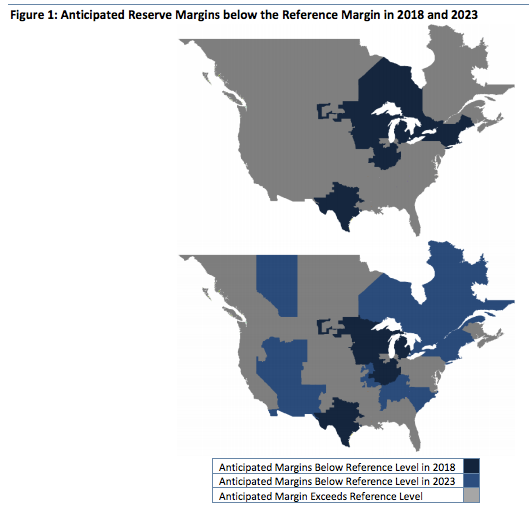
NERC 2013 Long-Term Reliability Assessment, page 5
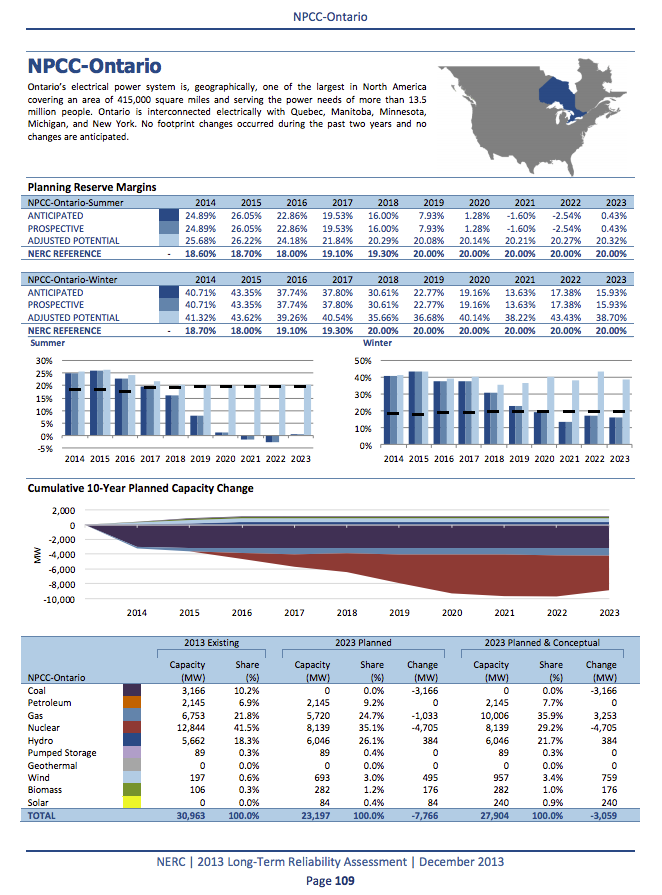
North American reliability standards are the domain of the North American Electric Reliability Corporation (NERC). Within a week of the release on the LTEP in Ontario,NERC released its 2013 Long-Term Reliability Assessment, which noted, “In the summer season of 2018, the NPCC-Ontario Anticipated Margin falls below the NERC Reference Margin Level.”

4 years is a very short time for developing reliable supply.

Ontario supply was tight in 2003, but work was underway for more; ~1250MW of capacity returned to service by the end of 2003, ~1400MW in 2004, and another 500MW in 2005. [1]

The firm supply Ontario added from 2003-2005 is different than the capacity additions planned for the next few years, which is primarily from variable intermittent energy sources (vRES); wind and solar.

OPA Slide from "Generation and Conservation Tabulations..."
The numbers shown by NERC won’t surprise the Ontario Power Authority (OPA), or Ontario’s system operator (the IESO).

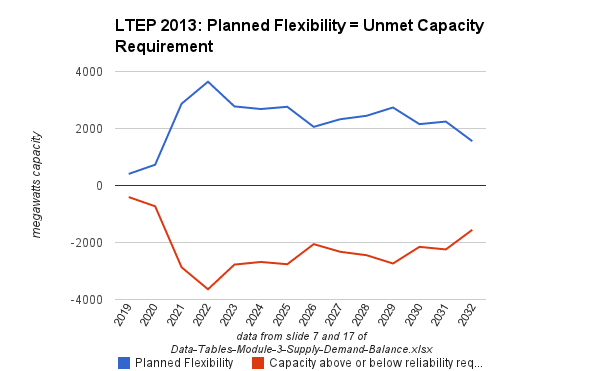
The OPA’s material demonstrating the figures behind Ontario’s LTEP also shows the capacity shortfall starting in 2019 and building to over 3,600 MW in 2022.

The plan is for Ontario to be in the same supply position a decade ahead of now as it was a decade behind.

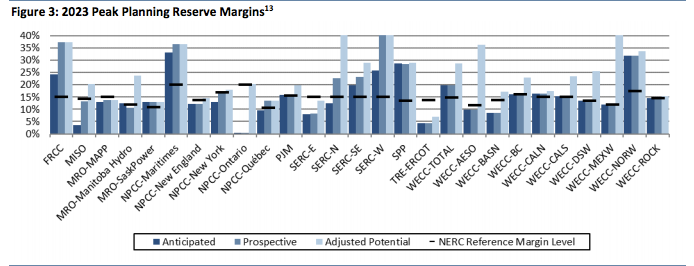
NERC’s forecast shows that, in two out of 3 models, Ontario is planned to have the lowest reserve margins in North America.
NERC’s models do offer Ontario a glimmer of hope in the “adjusted potential” scenario, which accounts for “the inclusion of less-certain resources, such as Conceptual capacity and nonfirm capacity transactions.” Problematically, NERC failed to anticipate the wide capacity scares of the past, “polar vortex”, winter. The trend for the near future is likely to treat “conceptual capacity and nonfirm capacity transactions” with a great deal of skepticism.
image+(16).png
From my recent "LTEP 2013: An unfinished plan"
The risks of new market tools and demand-side management advances not providing sufficient capacity are simply one looming problem for Ontario’s capacity requirements. The Long-Term Energy Plan (LTEP) released in December 2013 brushed off the reserve requirement issue by using a correcting entry in the generation column, calling it “planned flexibility.”

The plan also expected a great deal from existing nuclear power stations.

The LTEP’s commitment to nuclear is lukewarm, and possibly impractical.
Ontario plans to refurbish units at the Darlington and Bruce Generating Stations. The refurbishment has the potential to renew 8,500 MW over 16 years. The province will proceed with caution to ensure both flexibility and ongoing value for Ontario ratepayers. Darlington and Bruce plan to begin refurbishing one unit each in 2016. Final commitments on subsequent refurbishments will take into account the performance of the initial refurbishments with respect to budget and schedule by establishing appropriate off-ramps.
That sounds reasonable, but the LTEP’s refurbishment schedule may stack the deck against reliable nuclear operations; it shows Bruce B’s reactors operating for about 40 years prior to refurbishment. One expert analysis notes these units were predicted to need refurbishment due to components with a life of, “210,000 Equivalent Full Power Hours (EFPH) or 30 years at an 80 percent capacity factor.” Units at Bruce B will approach 300,000 EFPH if both the LTEP’s refurbishment schedule and its anticipated generation from nuclear power plants are met.

The Wynne government’s long-term energy plan promises only tepid commitments to maintaining the firm generation it currently possesses, and results in the continent’s worst forecast for meeting reserve requirements in the coming years despite projecting demand growth to be among the slowest on the continent.


Endnotes

1. most of this capacity was nuclear; Bruce units 3 (2004) and 4 (2003), and Pickering units 4 (2003) and 1 (2005). Bright Beach (natural gas) also entered service in 2004.

2. The section of NERC's 2013 Long-Term Reliability Assessment specifically for Ontario begins, with this graphic, on page 109:


Wednesday, 7 May 2014

Zombie docs living in Ontario's zombie budget

The Ontario government delivered its budget on May 1st; the NDP announced they would not be supporting the government any longer on May 2nd, and the Premier threw in the towel putting Ontario into an election campaign.
The budget may never have been intended to be practical, but created solely to be a "zombie" document to reference during a campaign.
bad data illustration from page 134 of the 2014 Ontario Budget

I was surprised to see the budget repeated a graphic based on the same Hydro-Quebec (HQ) report I debunked in picking apart Environmental Defence's lousy report on Ontario Energy Costs.

The HQ report graphs values of 12.475 cents/kilowatt hour (kWh) on a 1000kWh bill) for Toronto [1] and 12.391 cents/kWh for Ottawa.

I don't mean to criticize the HQ report, although those are the two figures I know best in it and they are wrong.

I do mean to criticize the former Ontario government that cynically included numbers from HQ in an Ontario budget.  While I'm at it, I'll criticize their base too - apparently the urban voters favouring the Liberal party can't figure out what they pay for electricity, and that it is not what their government tells them Quebec's public electricity company reports they are paying.


One more stab at showing HQ estimates are low.

image of TH interactive sample bill
The sample bill from the Toronto Hydro website shows pricing of $323.83 for 2000kWh of consumption over a 2 month period.

That works out as 1000kWh a month (as in the HQ study).
It works out as 16.2 cents/kWh (unlike the HQ study) - if you ignore that the Ontario Clean Energy Benefit discount is paid by taxes (or additional government debt).  Without the OCEB the bill is over 17.5 cents/kWh on consumption of 1000kWh.

This was the Ottawa Hydro sample bill [3]
The Ottawa Hydro sample bill is less coherent, but appears to be claiming using 800kWh a month would result in a bill of $127.16; an average of 15.895 cents/kWh.[3] That's 28% higher than the HQ study claims the Ottawa pricing was a year earlier.

Quite the inflation ... or just bad data in HQ's study.

I did note on these sample bills that neither Toronto's nor Ottawa's distribution companies have complied with Measurement Canada guidelines/rules on charging by metered readings; both still show an "adjusted" - meaning increased - consumption figure using a loss adjustment. [2]

That belongs in the delivery charge and the transition should be made 5 years ago (I think the Ontario Energy Board anticipates it will be made within a year).

Ottawa Hydro's sample bill is particularly entertaining as not only do they still tack on the tacky line-loss adjustment, but they show the 800kWh of metered consumption as being comprised of 466.11kWh Off-peak, 621.48 kWh mid-peak and 569.69 kWh on-peak.

Interesting math.

No wonder nobody pays much attention to the details on their bills - but I'm not sure they should continue to show the same disinterest in their ballots.


ENDNOTES

1. What is actually shown is $124.75 for a bill based on consumption of 1000kWh, which works out as $124.75/MWh or 12.475 cents/kWh

2.  My local distribution company (Hydro One) did cease the line-loss adjustment last year; the online hourly data they make available for download adjusted all figures back to the installation of my smart meter.

3. Soon after I wrote this, the sample bill on the Ottaws Hydro site was corrected - sort of.  The TOU rates now add up to 800kWh (if their billings are the same as my Ontario Hydro bill once was, they'd up to the "adjusted consumption" shown in the meter section of the bill, but it's now close).
When they fixed the figures the cost rose to $130.11, so it works out to 16.26 cents/kWh - essentially the same as the Toronto Hydro sample bill's average.

Sunday, 4 May 2014

Wither the I in the IESO: politics hit May's global adjustment estimate

It's called the IESO, for Independent Electricity System Operator, but it hasn't looked independent for some time, and never less so than this week.

On the afternoon of April 30th the IESO posted its "2nd Estimate" for April's Class B Global Adjustment (GAM) rates, and the "1st Estimate" for May's.  I noted a month ago how bad April's 1st estimate was; it was honestly bad.
May's first estimate of the GAM looks to be the opposite - dishonestly alright - and that's indicative of a bigger problem.

The budget released May 1st restated the Liberal government's desire to, "consolidate two electricity agencies — Ontario Power Authority (OPA) and the Independent Electricity System Operator (IESO)." A former bill to merge the two entities was introduced in 2012, but died when former Premier McGuinty prorogued the legislature and fled to Harvard. With the omnipresent threat of consolidation, there is not only the danger of a power struggle within Ontario's several electricity sector bureaucracies, but a danger that struggle will be won by sycophancy, and not capability nor competence.

The 1st Estimate

The public is not privy to the actual numbers used in calculating global adjustment estimates, but we do know the final figures, and the process is public.
pg 37 of  Market Manual 5, Part 5.5: Physical Markets Settlement Statements


Assuming consumption doesn't change a whole lot from month to month, we can use the rates ($/MWh) to estimate the 1st estimates. [1]

As an example:
last September the first estimate was a record $87.18/MWh.  That was close to the $62.45/MWh final GAM for August plus the difference between that final GA for August and the low 1st estimate ($40.13).  Ontario's record commodity rate, comprised of the Hourly Ontario Energy Price (HOEP) and the GAM, is $95.13(Feb. 2014), so the $87+ first estimate of the GAM component attracted some press attention at the time.

The 1st estimate for April 2014 was ridiculous in the context of an intelligent prediction of what pricing would be in April (natural gas price spikes ending along with winter).  The final GA for March (-$0.27/MWh) plus that figure less the first estimate for March (11.03) is -$11.57, and the 1st estimate was relatively close to that at $-9.65/MWh. This was obviously not going to be near the final global adjustment for April, but the 1st estimate for April does appear to be the result of the methodology

Not so for the 1st estimate for May 2014.

The 2nd estimate for April is $54.53.

That is $64.18 higher than the April first estimate of $-9.65/MWh - so the first estimate for May should be ~120/MWh ($54.53 plus $64.18)[2]; but it's posted as $53.56/MWh.  $53.56 will likely be a little low, but it's assuredly far closer to what the final May GAM will be than the ~$120/MWh.

The concern is why the IESO dumped their methodology for May, but not for April.

The most likely reason the IESO altered course is the threat, now realized, of the government falling and a pending election.


Politically

The estimates of the global adjustments aren't just estimates; customers can be billed at any of the 3 rates depending on their billing cycle.  With the average weighted Hourly Ontario Energy Price (HOEP) being ~$33.3/MWh (in Aprile), that means some consumers will be seeing partial billings for April of ~$23.65/MWh, using the first estimate of the GAM of $-9.65.

Not bad for the last bill before a ballot - but some others may get bills before the June vote charging May's usage based on the first estimate for May: now they'll be billed at the HOEP (say $30/MWh) plus the estimated $53.56 - probably still lower than average total commodity cost. If May's global adjustment was set at $120/MWh, the average for April and May on billings using the 1st estimate of the GAM would be ~$87/MWh - which is close to what the average weighted HOEP, plus the final global adjustment charges, will be for April and May.

Instead of a high May first estimate recovering the cost of supply from consumers billed on the low first estimate in April, the costs will spill into future months pools of the global adjustment.

Why?


Other Points of Interest

From the Ontario Energy Board (OEB):

The OEB posted a speech delivered by it's Chair and CEO, Rosemarie T. Leclair; Consumer-Centric Regulation: From Vi son to Reality.  Some of the headings: "Consumer Centric Regulation at the Board",
"Energy Literacy":, "Public Engagement and Public Trust" ... if you follow energy in Ontario at all, you know the spiel.

The limitations of "communication" strategies is apparent in an important initiative the OEB is undertaking, "Rate Design for Electricity Distributors."  A deadline for written comments was extended this past week (to June 6).

The initiative is excellent, and the draft report explains why it's necessary.

But the draft report also repeats a lot of the nonsense from the time-of-use (TOU) planning, on the need for simplicity in rate structures and, particularly, a need for being revenue neutral.

Electricity pricing in Ontario used to be progressive.  As TOU pricing bumps the old tiered rate, it means a rate hike for a frugal consumer of electricity with a typical usage pattern and consumption entirely within the lower tier of consumption (600kWh per month in the summer, 1000kWh per month in the winter).  As of May 1st the average rate in Ontario will be 9.25 cents/kWh; the lower tier price 8.6 cents/kWh; meaning a low consumption customer pays 7.5% more on the new, simple, revenue neutral TOU rates than under the older tiered structure.

The people paying less on TOU (because of the revenue neutrality basis) are those with significant consumption in the higher tier (10.1 cents per kWh).  This is unnecessarily regressive because it's unnecessarily simple.

Similarly, the cost of distribution currently has a high component based on per/kWH charges on electricity consumption, and that has generally been a progressive pricing scheme.  The OEB's draft report doesn't indicate any concern with creating another pricing policy that transfers costs to poorer, lower consumption households.

I'd suggest either revenue neutrality needs to be abandoned, in order to recover additional funds to subsidize lower income households, or a more complicated pricing structure need to be implemented that guarantees little price movement in the lower consumption households.

The most complicated of the OEB's pricing plans for distribution is "Proposal 3 – a fixed monthly charge where the size of the charge is based on use during peak hours."  It's also the closest to being fair - although I'd go by simply peak draw as opposed to draw at system peak (annual or, better yet, 2 periods a year for winter and summer).

Proposal 3 is also the most complicated; proposal 2 (size of connection) along with a recognition of the impact of the change on lower income households, and government action to compensate for the increase, may be more sensible.

Regardless of what is decided, communicability is not a greater goal than fairness - and fairness is not an easy thing to communicate.


END NOTES

1. The market manual outlines a methodology for calculating a bulk dollar amount and consumption - then calculating the rate, but only the rates are publicly displayed, not the component figures used in the calculation of the rate.
Aside from the fact demand does change from month to month (most significantly due to temperature change), there is no disclosure of any component figures used in calculating the global adjustment total amount - including, most egregiously, adjustments for misses in previous months.

2. The second estimate of a month's global adjustment is also not a clean reflection of what the final global adjustment is predicted to be (at the time the 2nd estimate is posted) as it also is impacted by adjustments for the previous month. In this post I've compared final global adjustments and 1st estimates from the previous month for all figures except for May 2014, where only the 2nd adjustment is available.  In other words, we don't know exactly what the methodology should produce as 1st estimate for May's global adjustment, but we do know it is almost certainly should have been between $105 and $140/MWh.